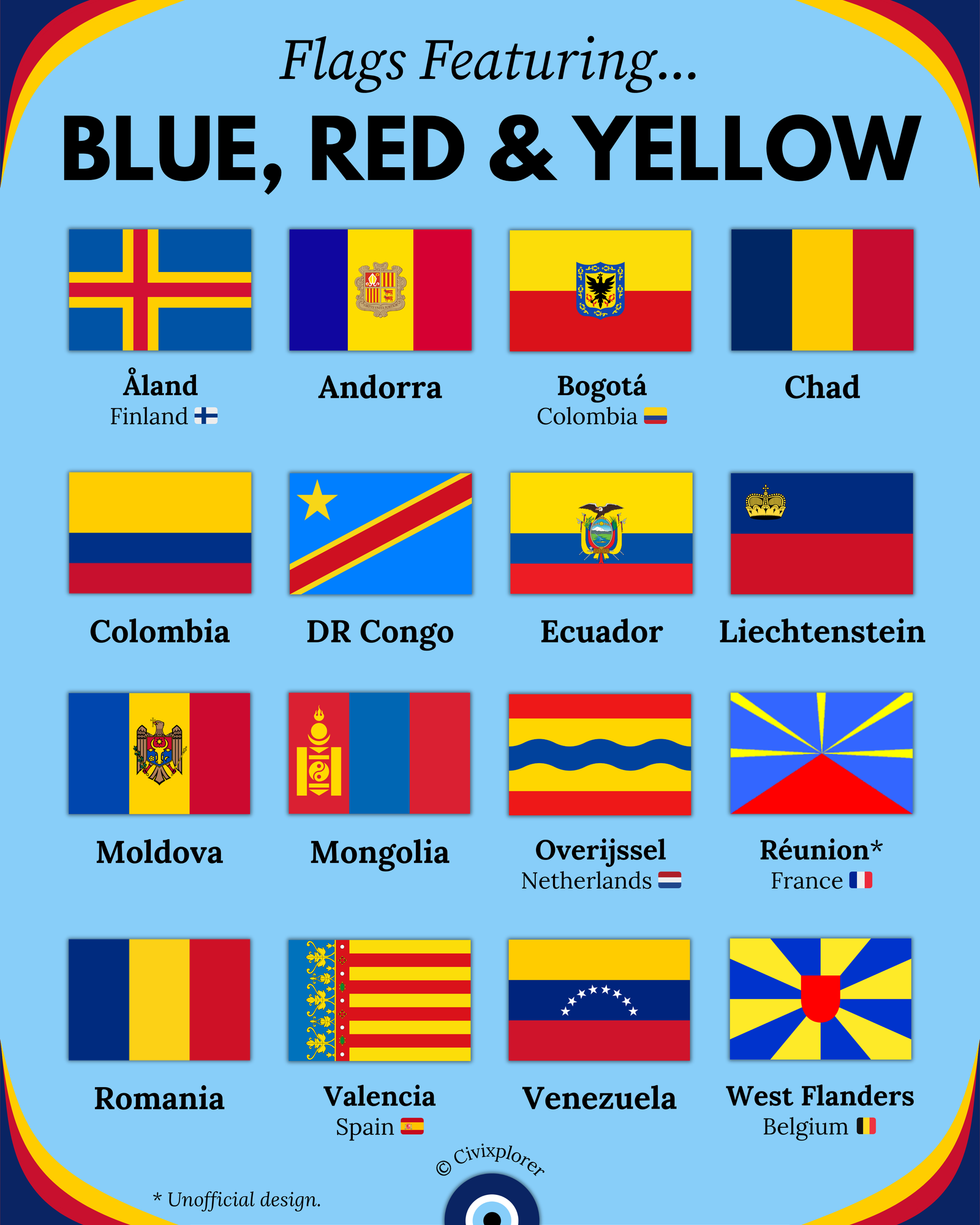
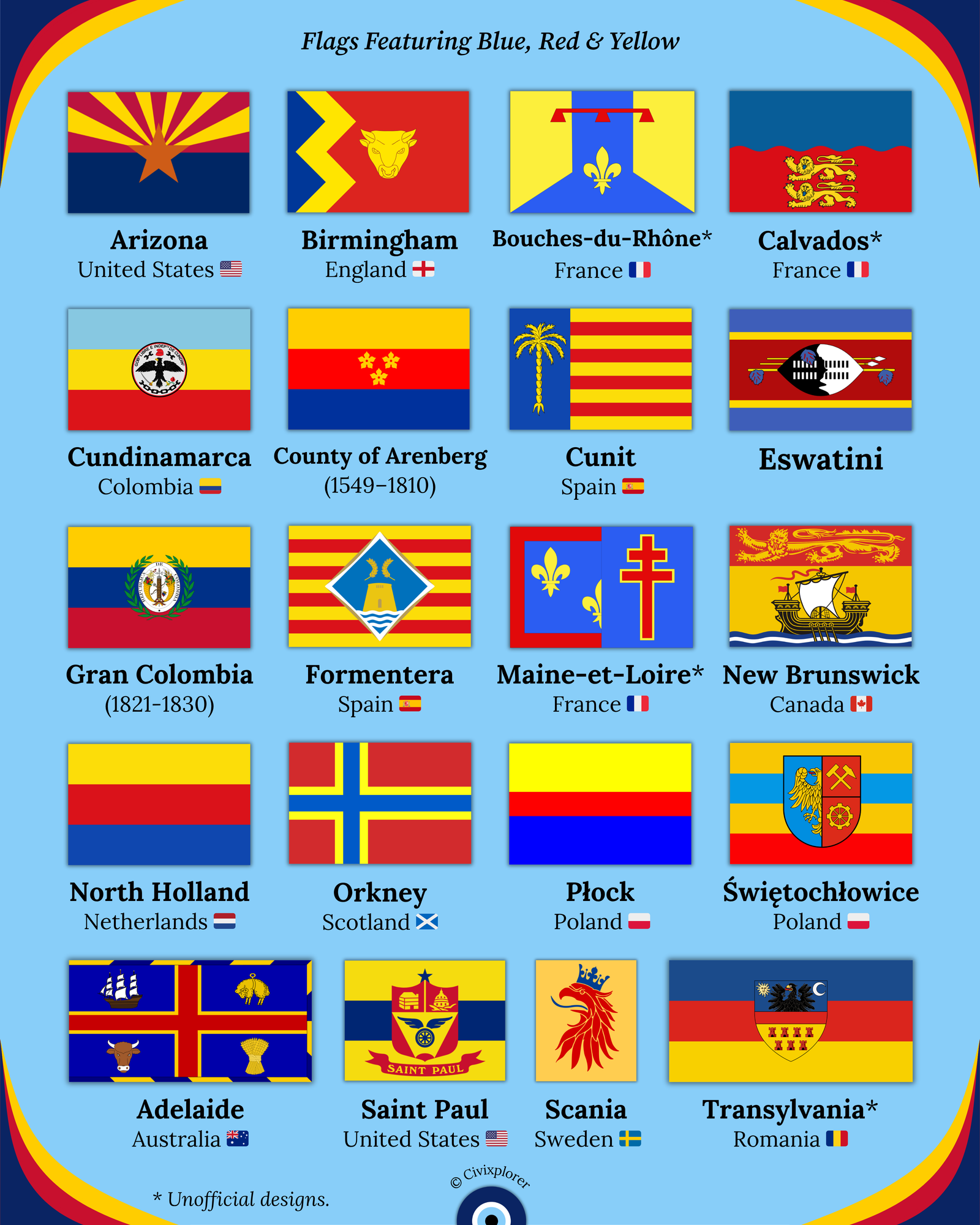
The study of flags, known as vexillology, reveals that the choice of color is never arbitrary. These two infographics from Civixplorer showcase a fascinating cross-section of global flags—ranging from sovereign states to historical republics—that share a common palette: the primary colors of blue, red, and yellow. Using these three foundational hues is a masterclass in high-contrast design, ensuring that symbols remain recognizable from great distances or while flapping in the wind.
While these colors appear together frequently, their meanings are deeply rooted in specific cultural and geographical contexts. Generally, blue evokes the sky or bodies of water, symbolizing freedom, vigilance, and peace. Red almost universally represents the blood shed by founders and martyrs, as well as valor and revolutionary energy. Yellow (or gold) typically signifies a nation’s material wealth, agricultural prosperity, or the generative power of the sun.
One of the most prominent historical groupings highlighted in these visuals is the legacy of Gran Colombia. The flags of Colombia, Ecuador, and Venezuela all derive from a design by Francisco de Miranda in 1801. In this context, the yellow represents the resource-rich land of the Americas, the blue symbolizes the Atlantic Ocean separating their territory from Spain, and the red honors those who died for independence. This shared palette remains a deliberate pan-regional statement of unity.
A different but equally compelling pattern is found in the vertical tricolors of Romania, Moldova, and Andorra. Interestingly, the flag of Chad is almost identical to Romania’s, a phenomenon known as one of the world's closest "flag twins". While Romania’s colors represent the union of its historical principalities, Chad’s colors blend the French Tricolor with Pan-African ideals, making their similarity a fascinating historical coincidence.
The infographics also delve into European heraldic traditions and regional identities. The flags of Valencia and Formentera feature the Senyera, the historic red and yellow stripes of the Crown of Aragon, one of the oldest flag designs in Europe. Meanwhile, the flags of Åland and Orkney utilize the Nordic Cross to visualize complex identities—Åland uses Swedish colors with a Finnish red cross, while Orkney combines Norse heritage with Scottish heraldry.
Beyond Europe and the Americas, the trio appears in the Democratic Republic of Congo, where the blue field represents the Congo River and hope, and in Mongolia, where the yellow soyombo emblem serves as a Buddhist symbol of eternal freedom. These examples illustrate that while the palette of blue, red, and yellow is limited, its ability to tell stories of sovereignty, sacrifice, and aspiration is truly universal.
Comments (0)
Join the Conversation
Login to share your thoughts with the community.
Login to Comment