
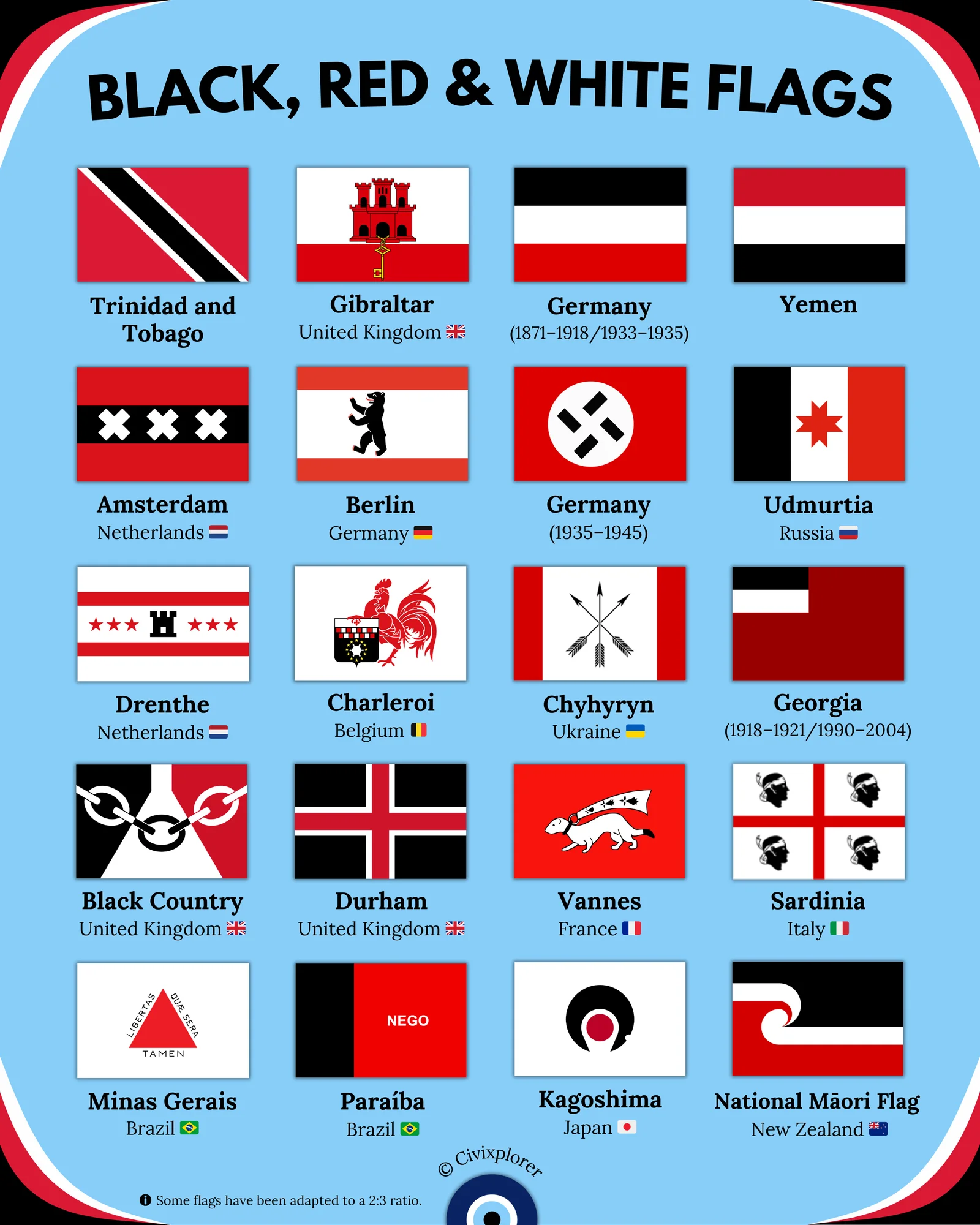
The combination of black, red, and white creates one of the most visually arresting palettes in the world of vexillology. While these colors appear together on flags across every continent, their origins are rarely the same. From the "Power" colors of 19th-century empires to modern symbols of industrial heritage and indigenous identity, this specific trio tells a complex story of global history.
Historically, this color scheme was often associated with imperial might. The German Empire (1871–1918) famously combined the black and white of Prussia with the red and white of the Hanseatic League. In the Middle East, flags like that of Yemen utilize these colors as part of the Pan-Arab movement. In this context, black represents the dark days of past oppression, white symbolizes a bright future, and red honors the blood shed for independence and freedom.
Regional identities also lean heavily into this palette to showcase their unique heritage. Amsterdam’s iconic triple "X" flag uses red and black from the city’s traditional coat of arms, while the "Four Moors" flag of Sardinia dates back to the 13th century, representing historical victories in the Mediterranean. Even in the United Kingdom, the Black Country flag uses these colors to represent the region's role in the Industrial Revolution—black for coal and soot, and red for the glow of the furnaces at night.
Beyond traditional statehood, these colors hold deep spiritual and political meanings. The National Māori Flag of New Zealand uses black to represent the realm of potential, red for the Earth Mother, and white for the physical world of light. Similarly, the flag of Paraíba in Brazil features the word "NEGO" (I deny), commemorating a 1930 political revolution and the courage of its leaders.
Whether they represent a volcanic island in Japan's Kagoshima or a Masonic-inspired independence movement in Brazil's Minas Gerais, black, red, and white remain a testament to human resilience. Black embodies strength and determination, red signifies sacrifice and passion, and white stands for peace and purity. Together, they create a visual language that is as much about the past as it is about the future.
Comments (0)
Join the Conversation
Login to share your thoughts with the community.
Login to Comment