
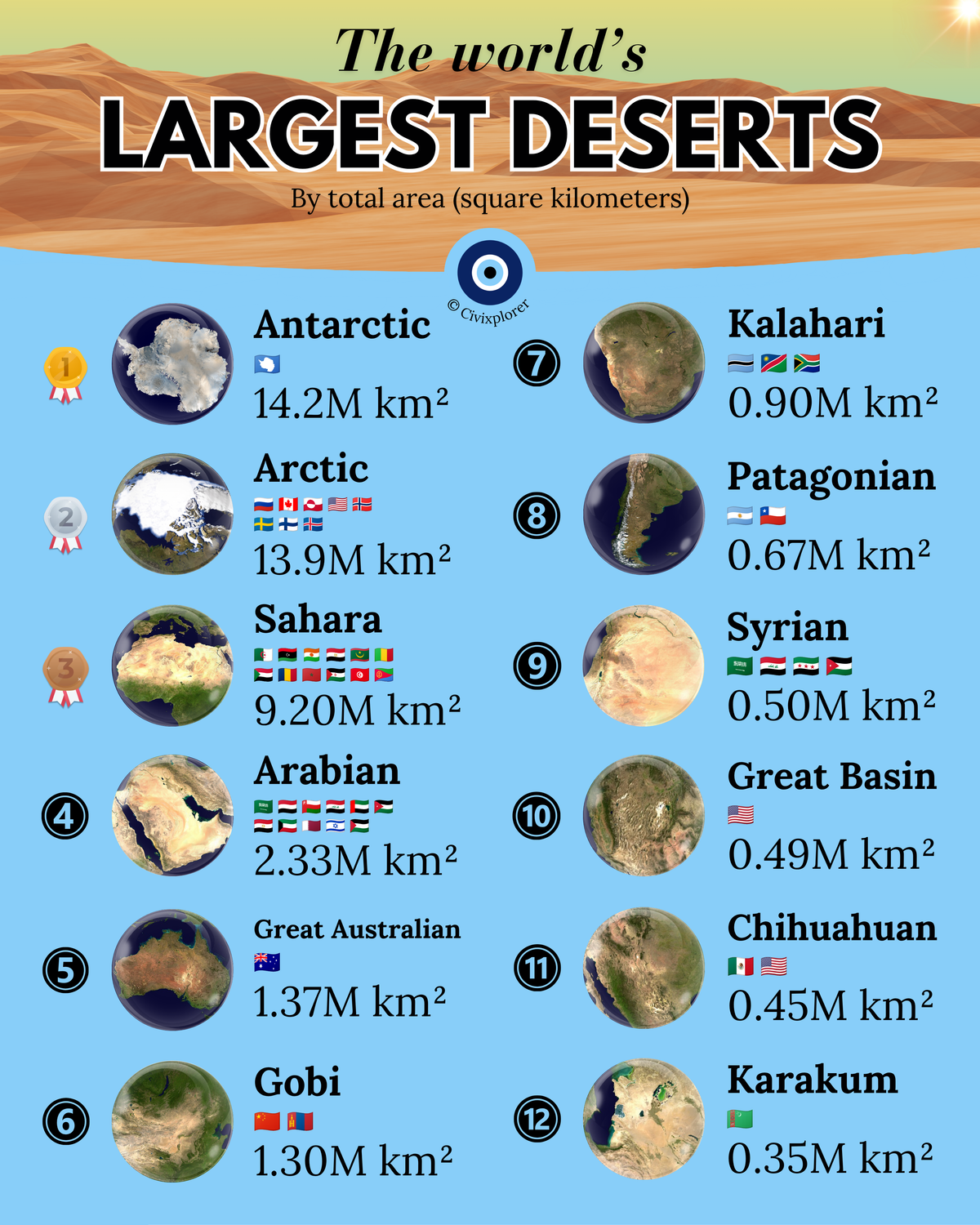
When most people imagine a desert, they picture endless dunes of shifting orange sand and a blistering sun. However, in the world of geography, a desert is strictly defined by aridity—specifically, any region that receives less than 250 millimeters (about 10 inches) of annual precipitation. Because temperature is not the deciding factor, some of the driest places on Earth are also the coldest.
The Polar Giants
The global ranking is dominated by the Antarctic Desert, which at 14.2 million km² is the largest desert on Earth. Despite being covered in ice that holds 90% of the world's surface freshwater, the interior is so cold that the air cannot hold moisture, resulting in precipitation levels lower than the driest parts of the Sahara. Following closely is the Arctic Desert at 13.9 million km². Unlike its southern counterpart, the Arctic is not a single continent but an aggregate of polar ice, tundra, and arid zones across northern nations like Russia, Canada, and the United States.
Subtropical and Hot Deserts
The Sahara ranks as the third-largest desert overall and the world's largest hot desert, covering 9.20 million km² across North Africa. Its immense scale is comparable to the entire landmass of the United States or China. Further east, the Arabian Desert (2.33 million km²) dominates the Middle East, containing the Rubʿ al-Khālī or "Empty Quarter," which is the largest continuous sand sea on the planet.
The Influence of Geography and Rain Shadows
Many mid-sized deserts owe their existence to mountain ranges that block moisture, a phenomenon known as the rain-shadow effect. The Gobi Desert (1.30 million km²) in Asia is a classic cold-winter desert formed because the Himalayas block moist air from the Indian Ocean. Similarly, the Patagonian Desert (0.67 million km²) in South America is kept dry by the towering Andes Mountains.
In North America, the Great Basin (0.49 million km²) is a cold desert shaped by the rain shadow of the Sierra Nevada, while the Chihuahuan Desert (0.45 million km²) stands as the continent's largest hot desert. These diverse landscapes, from the red sands of the Kalahari to the "black sands" of the Karakum, remind us that the "eye of the world" sees beauty in even the most extreme and arid environments.
| Rank | Desert Name | Total Area (M km²) |
|---|---|---|
| 1 | Antarctic | 14.2M km² |
| 2 | Arctic | 13.9M km² |
| 3 | Sahara | 9.20M km² |
| 4 | Arabian | 2.33M km² |
| 5 | Great Australian | 1.37M km² |
| 6 | Gobi | 1.30M km² |
| 7 | Kalahari | 0.90M km² |
| 8 | Patagonian | 0.67M km² |
| 9 | Syrian | 0.50M km² |
| 10 | Great Basin | 0.49M km² |
| 11 | Chihuahuan | 0.45M km² |
| 12 | Karakum | 0.35M km² |

Comments (0)
Join the Conversation
Login to share your thoughts with the community.
Login to Comment