
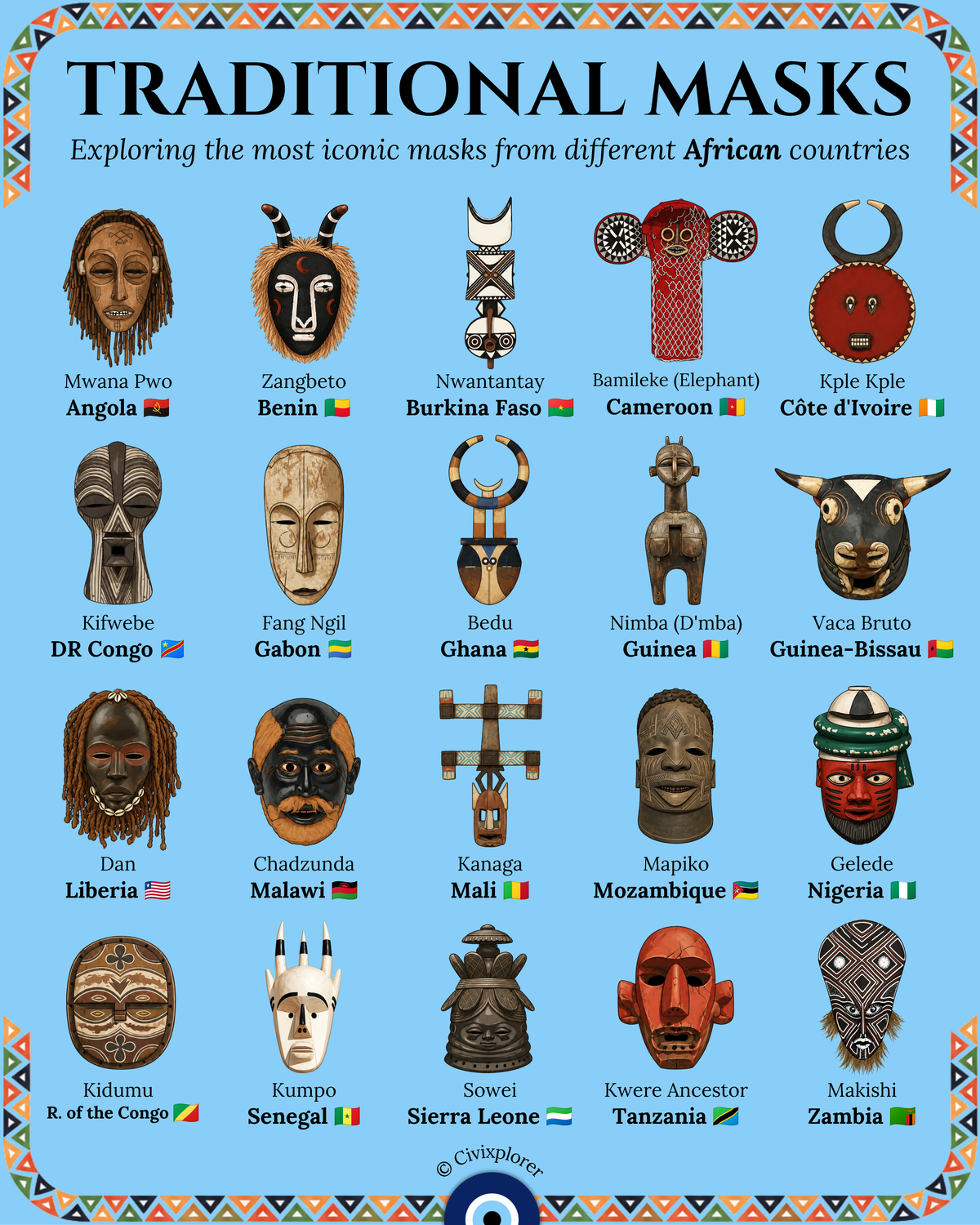
Across the African continent, traditional masks are far more than decorative objects or static museum pieces. To understand them, one must look past the wood and pigment to the performer, costume, music, and ritual context that bring them to life. In many societies, a mask is a dynamic vessel—a temporary embodiment of ancestors, spirits, social ideals, and collective memory.
One of the most important aspects of these traditions is that they often predate modern political borders. While we might label a mask by a specific country today, these traditions belong to ethnic groups that cross national lines. For example, the Chokwe traditions span across Angola, the Democratic Republic of the Congo, and Zambia, while Fang art is found in Gabon, Equatorial Guinea, and Cameroon.
The stylistic diversity of these masks is staggering because they serve a vast array of social functions. Some are central to initiation ceremonies, teaching young people moral and spiritual knowledge. Others are used in funerary rituals to guide ancestors, while many represent political authority or serve as tools for social control.
Among the most iconic examples is the Mwana Pwo of the Chokwe people. This mask represents a female ancestor and celebrates feminine beauty and fertility. Fascinatingly, although it depicts a woman, it is traditionally worn by a male dancer. This highlights a core principle of African masking: the mask does not merely hide an identity; it creates a new one.
In contrast to the delicate features of the Mwana Pwo, the Zangbeto of Benin represents a non-human force. Known as the "guardians of the night," these costumes are made of towering layers of colored straw. They historically functioned as a form of community protection and social control, believed to possess the supernatural power to identify wrongdoing.
For the Bwa people of Burkina Faso, the Nwantantay plank masks use bold geometric designs to represent spirits of the wilderness. Here, realism is not the goal. Instead, the abstract forms communicate that the spirit belongs to a realm beyond ordinary human existence. Similarly, the Nimba (or D'mba) headdress of the Baga people in Guinea uses monumental size to emphasize the importance of maternal fertility and agricultural abundance.
While many masking traditions are male-dominated, the Soweï helmet mask of the Mende people in Sierra Leone is a rare and remarkable exception. It is one of the few traditions historically controlled and performed by women within the Sande society, representing ideals of feminine dignity and maturity.
Ultimately, these masks are functional and transformative. Whether it is the Kanaga mask of the Dogon used to guide souls in funeral rites or the Gelede of the Yoruba honoring the spiritual authority of elderly women, each mask serves as an unbroken library of indigenous knowledge. They remain a powerful testament to the relationship between a community and the spiritual forces they believe govern their world.

Comments (0)
Join the Conversation
Login to share your thoughts with the community.
Login to Comment