
The global landscape of the French language is undergoing a profound geopolitical and demographic transformation. For centuries, the heart of the Francophone world was undeniably European, centered on the historic streets of Paris. However, new projections for 2026 reveal a decisive migration of this linguistic center of gravity toward the African continent. Today, the most populous French-speaking urban areas are no longer defined by European borders, but by the rapid urbanization and explosive growth of Sub-Saharan Africa.
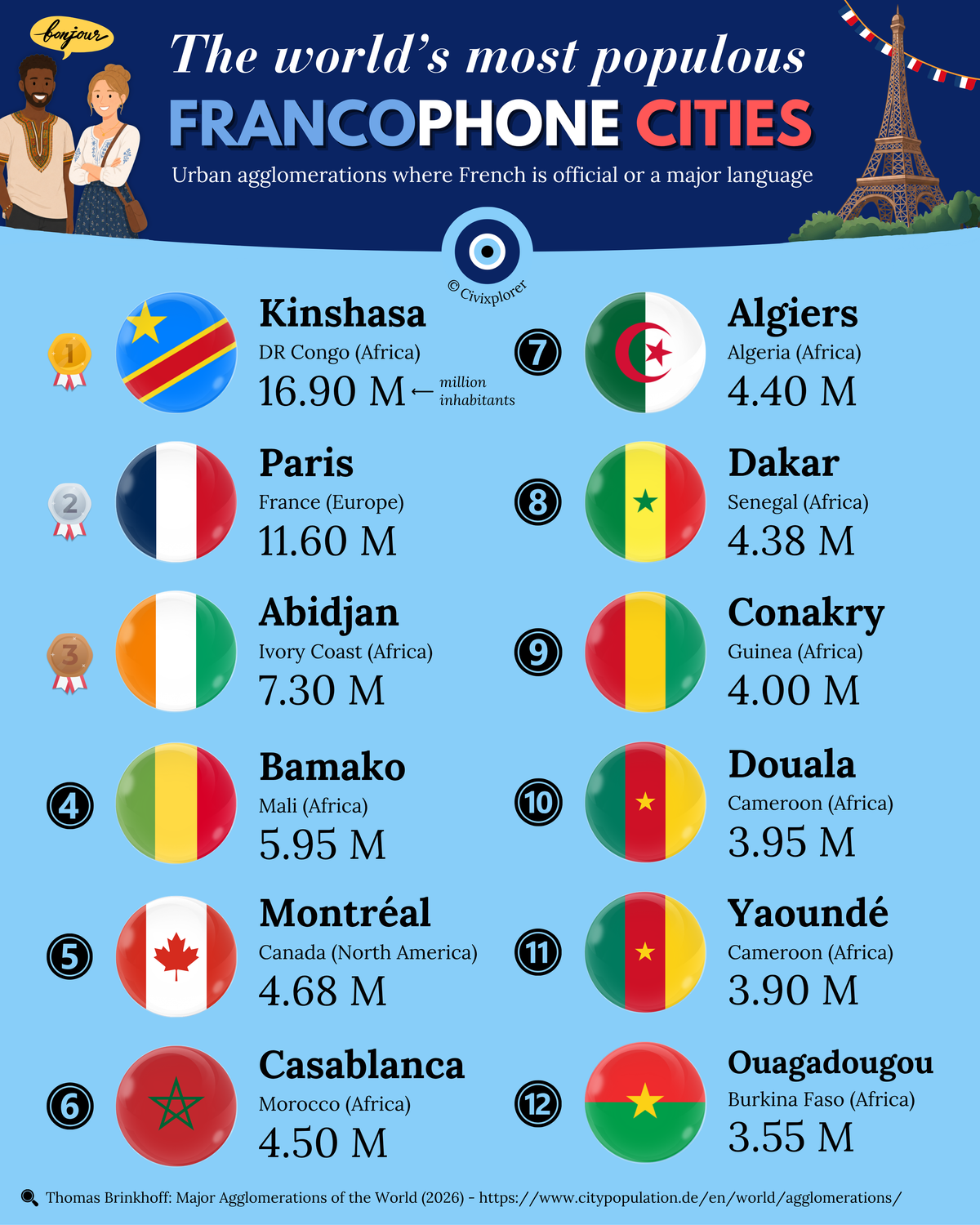
At the pinnacle of this shift is the Kinshasa Phenomenon. The capital of the Democratic Republic of the Congo (DRC) has officially eclipsed Paris to become the largest Francophone urban agglomeration in the world. With a projected population of 16.90 million, Kinshasa now leads Paris by a margin of over 5 million people. This growth is fueled by a combination of high natural birth rates and a massive influx of residents seeking economic opportunity or fleeing regional instability. While the Belgian colonial legacy established French as the language of administration, it is modern Congolese demographics that have turned Kinshasa into the new demographic capital of the French language.
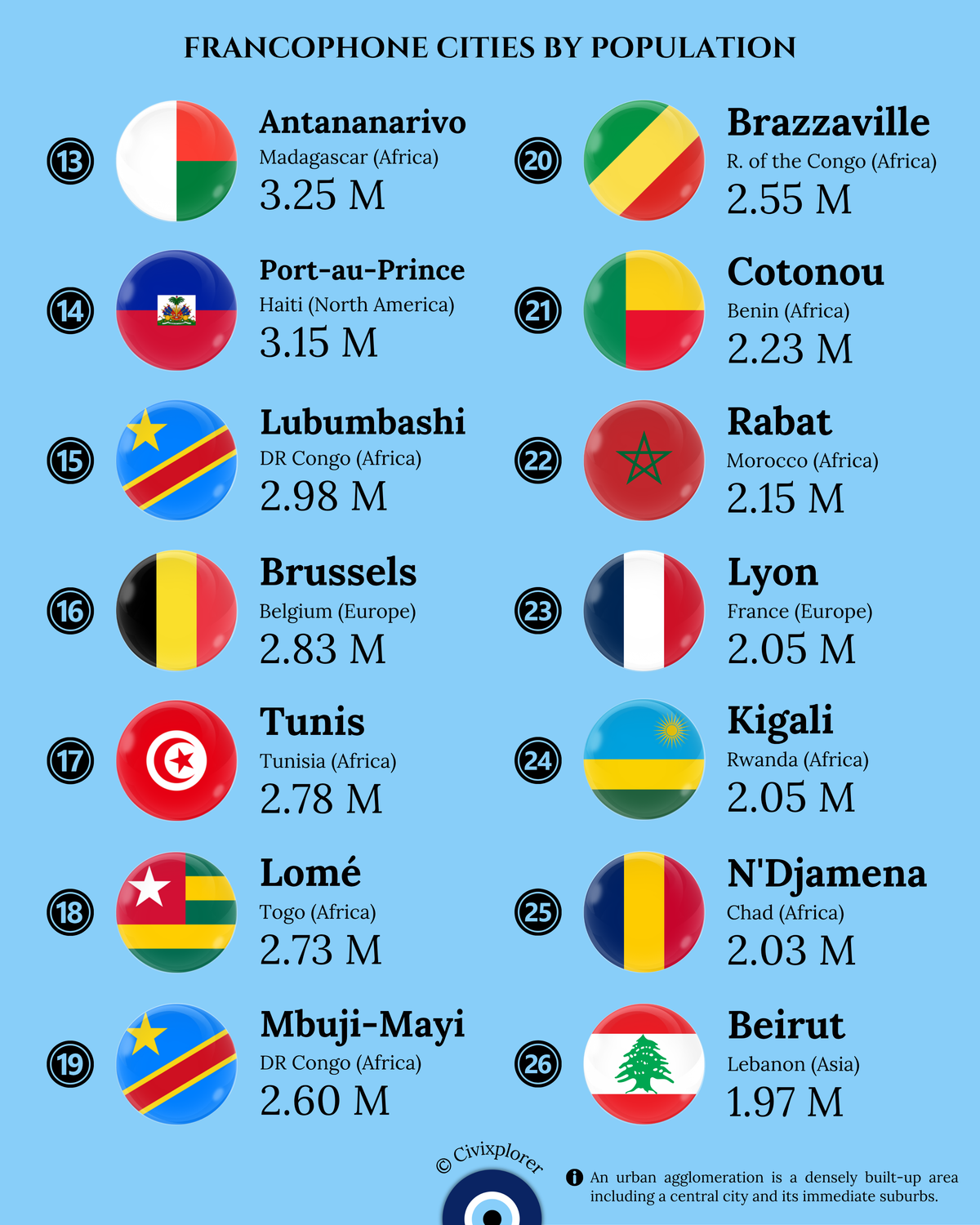
The dominance of Africa is not limited to a single city. Out of the 26 most populous Francophone urban agglomerations, 20 are located in Africa. Cities like Abidjan (7.30 M), Bamako (5.95 M), and Dakar (4.38 M) are expanding at unprecedented rates. This "Africanization" of the language is driven by two primary factors: a demographic explosion characterized by high fertility rates and the continued use of French as a post-colonial lingua franca. In multi-ethnic nations with hundreds of distinct local languages, French serves as a neutral medium for government, education, and inter-ethnic communication.
In the Maghreb region of North Africa, a different linguistic nuance exists. Major hubs like Casablanca (4.50 M), Algiers (4.40 M), and Tunis (2.78 M) rank high on the list despite French not being the primary official national language. In these nations, French remains deeply entrenched as a "working language" essential for business, higher education, medicine, and international diplomacy. This functional classification as Francophone agglomerations highlights the enduring influence of historical ties and colonial history in the region's urban life.
Outside of the African continent, only a few major outliers remain. Paris (11.60 million) remains the symbolic and institutional heart of the language, but its growth has stabilized in line with mature European urbanization. Montréal (4.68 M) stands as the principal French-speaking metropolis in North America, maintained through rigorous provincial language laws. Meanwhile, Beirut (1.97 M) represents the sole Asian entry, a legacy of the post-WWI French mandate where the language continues to hold significant prestige in the educational system and among the bourgeoisie.
As we look toward the future, the cultural evolution of French—including its slang, literature, and media—will increasingly be shaped by the streets of Kinshasa and Abidjan rather than the salons of Paris. The demographic weight has shifted, and the future of the Francophone world is undeniably African.

Comments (0)
Join the Conversation
Login to share your thoughts with the community.
Login to Comment