The Christian cross, though fundamentally centered on a single historical event, became one of the most flexible visual languages through which European societies expressed power, memory, belonging, and political legitimacy for over a thousand years. Interestingly, the earliest Christians did not immediately adopt the cross as their primary symbol, choosing instead more discreet emblems like the fish, the Good Shepherd, or the Chi-Rho monogram. It was only after Emperor Constantine’s conversion in the fourth century that the cross rose to prominence, eventually evolving from a standard instrument of crucifixion into hundreds of regional, dynastic, military, and artistic variations. As the Christian faith spread across Europe, it did not simply erase local customs; instead, it adapted to local geographies, existing religious frameworks, and political movements, creating a beautiful tapestry of cultural syncretism.
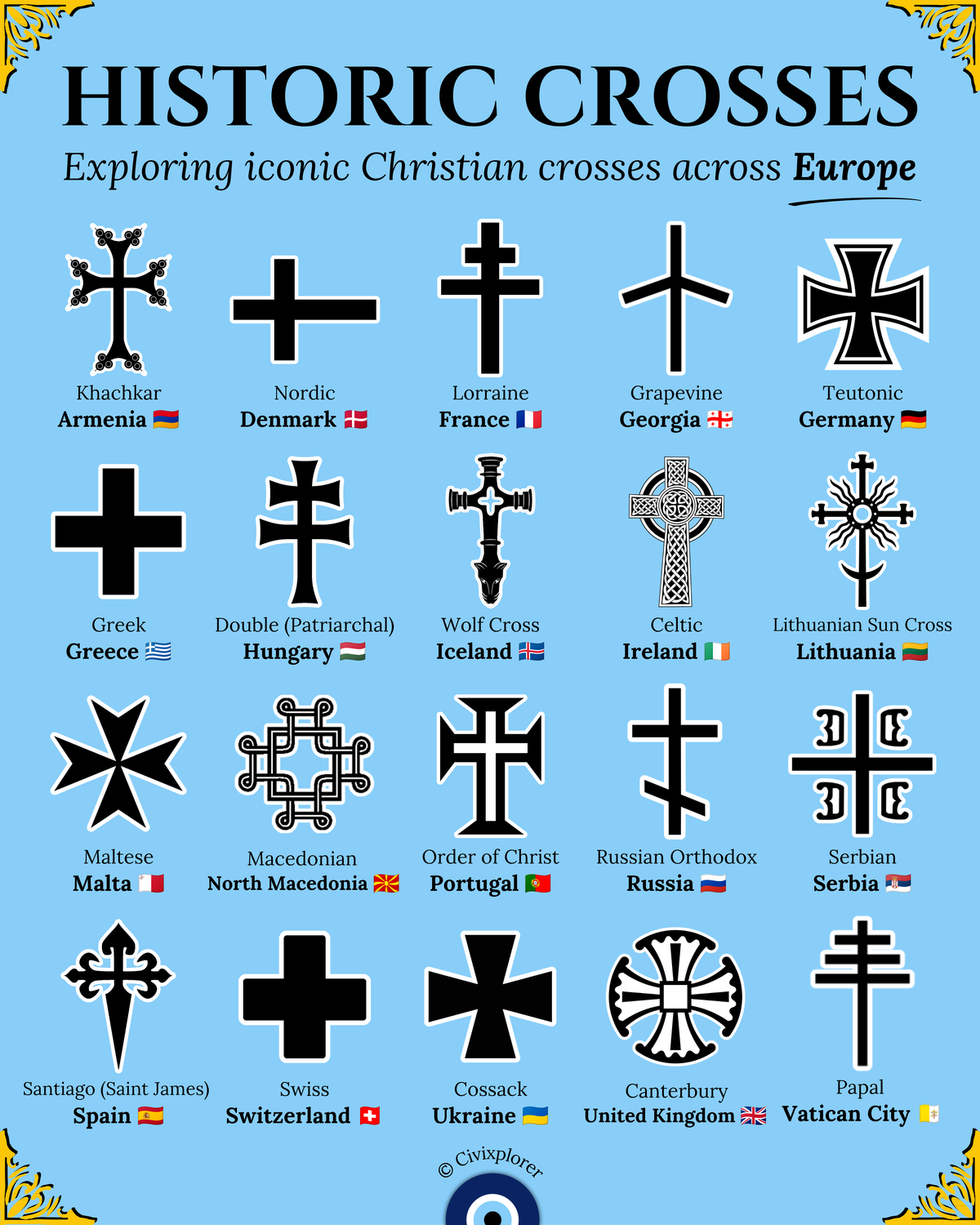
One of the most fascinating aspects of this evolution is how early missionaries and local populations blended traditional beliefs with Christian iconography to make the new faith more relatable. In Scandinavia, the tenth-century Icelandic Wolf Cross discovered at Foss serves as a perfect example of this transition. Crafted as a pendant, its unique design allowed it to function as both a Christian cross and Thor's Hammer (Mjölnir), helping Viking merchants safely navigate and trade with both pagan and Christian populations. Similarly, the Lithuanian Sun Cross reflects the late Christianization of Europe's last pagan polity in 1387, incorporating ancient Baltic solar and agricultural motifs that preserve a deep connection to nature worship. Even the world-famous Celtic Cross of Ireland beautifully merges the traditional Latin cross with a prominent ring or nimbus, which is widely believed to be an intentional adaptation of Celtic sun symbols used by early missionaries, though it also provided crucial structural support for massive stone monuments.
In the South Caucasus, the Christian cross became deeply intertwined with local cultural expression, developing artistic traditions that stood entirely independent of Western European influences. The Armenian Khachkar, or cross-stone, is not a simple symbol on a shield but a freestanding monumental stele carved out of volcanic tuff stone. Emerging prominently in the ninth century, these unique monuments depict crosses surrounded by dense interlace, grapevines, and rosettes that transform the symbol into a victorious "Tree of Life". Just across the border, Georgia's Grapevine Cross represents a highly intimate connection to national identity. Historically tied to Saint Nino, a fourth-century woman who evangelized the region, this cross features distinctive drooping arms because she reportedly fashioned it from grape branches bound with her own hair. By incorporating the grape, this design elegantly fuses the central Eucharistic mystery of Christianity with Georgia's ancient, thousands-of-years-old viticultural heritage.
During the Middle Ages, the rise of powerful military orders transformed these religious emblems into potent symbols of political authority, warfare, and state-building. In the Iberian Peninsula, the Santiago Cross was designed as a sword with a floriated hilt, representing the dual mandate of the twelfth-century Knights of Santiago: to defend territory and protect pilgrims traveling the Camino de Santiago. Nearby, the Portuguese Order of Christ Cross, which succeeded the Knights Templar, was famously painted onto the sails of caravels during the Age of Exploration. It became a global symbol of maritime expansion, linking crusading ideology with imperial discoveries in Brazil and India. Meanwhile, the iconic eight-pointed Maltese Cross of the Knights Hospitaller came to represent the eight foundational obligations or beatitudes of the order, showcasing how institutional ethics could be physically represented through geometric design.
As centuries passed, many of these crosses transitioned from ecclesiastical and dynastic markers into modern symbols of national unity and political resistance. The Cross of Lorraine, a double-barred patriarchal cross with roots in Byzantine and Hungarian royalty, was famously adopted by General Charles de Gaulle as the official emblem of Free French forces during World War II. By choosing this ancient symbol, de Gaulle created a powerful counter-emblem to the Nazi swastika, turning a medieval religious sign into a modern beacon of republican legitimacy and resistance. Similarly, the Serbian Cross incorporates a traditional cross flanked by four firesteels that are popularly read as Cyrillic letters representing the national motto "Only Unity Saves the Serbs," serving as a profound national emblem of cohesion and survival. Whether used as a field sign of the Old Swiss Confederacy or as the basis of the globally influential Nordic flags pioneered by Denmark's Dannebrog, these historic crosses prove that sacred iconography is never static; it is a living reflection of history, culture, and identity.

Comments (0)
Join the Conversation
Login to share your thoughts with the community.
Login to Comment