
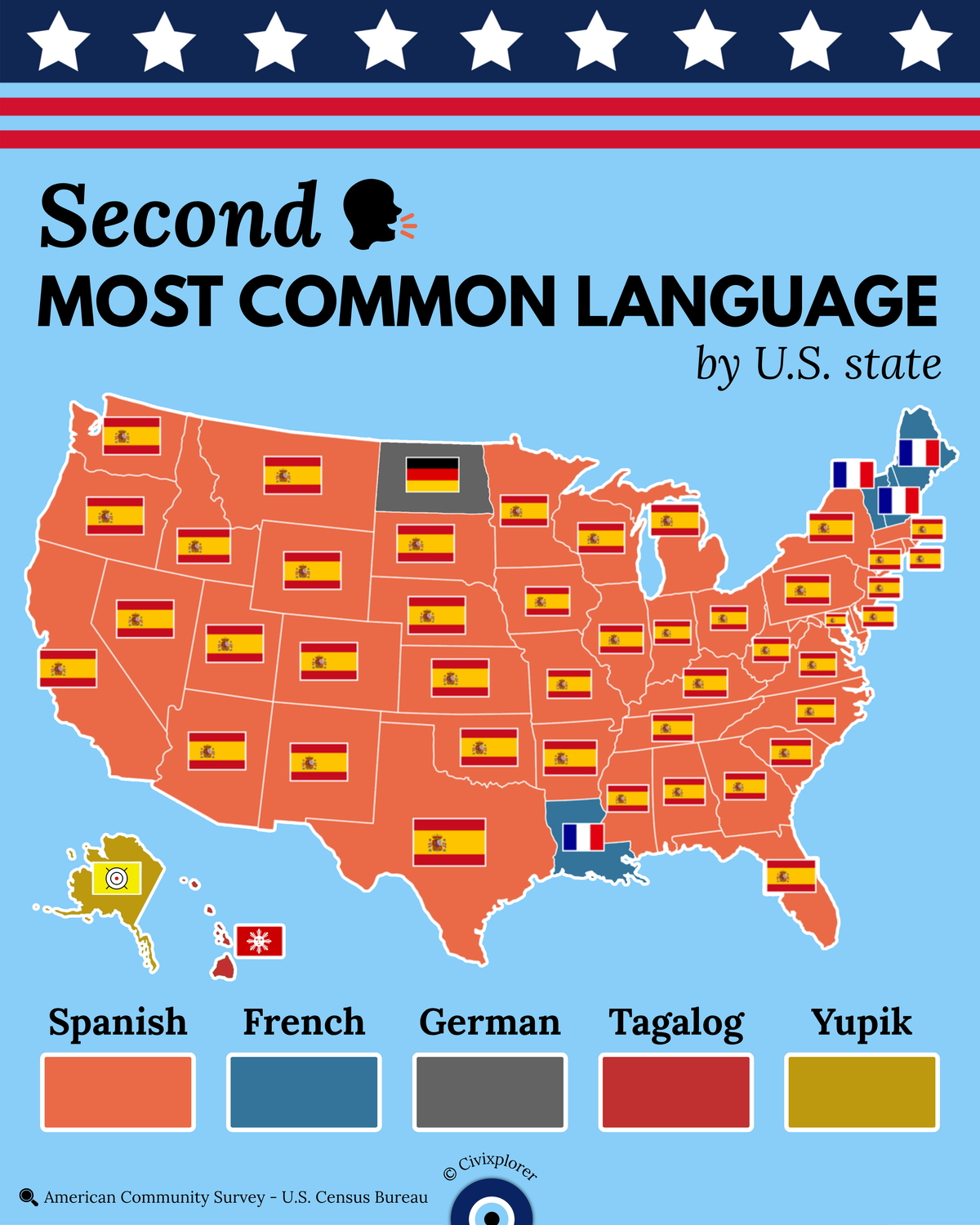
The United States is often perceived as a monolingual nation, yet its linguistic landscape is a rich, multi-layered tapestry woven from centuries of migration, colonial expansion, and indigenous resilience. By utilizing data from the U.S. Census Bureau’s American Community Survey (ACS), we can look past the dominance of English to uncover the "second" language of each state. This demographic fingerprint reveals a fascinating map of human movement and cultural survival.
The Overwhelming Dominance of Spanish
It is no surprise that Spanish is the most common non-English language spoken at home in 43 out of 50 states. Nationally, more than 43 million people speak Spanish at home, representing roughly 13% to 14% of the total population. This dominance is driven by two distinct forces: historical territorial legacy and modern immigration. Large swaths of the American Southwest—including California, Texas, Arizona, and New Mexico—were part of the Spanish Empire and later Mexico long before they joined the Union. In the modern era, sustained migration from across Latin America has reinforced these patterns, making Spanish a near-universal second language from the Atlantic to the Pacific.
The German Anomaly in the Great Plains
Perhaps the most striking visual outlier on the map is North Dakota, the only state where German ranks as the second most spoken language. This is a testament to the massive influx of "German-Russians" in the late 19th and early 20th centuries. These ethnic Germans, who had previously settled in the Russian Empire, brought their agricultural expertise and distinct dialects to the harsh climates of the Dakotas. Today, while much of the population has assimilated, the language persists within older generations and insular ethnoreligious communities like the Hutterites and Mennonites.
The Dual Stories of French in America
French holds the number two spot in five states, but the reasons vary significantly by region. In Louisiana, the presence of French is a direct result of its colonial history and the arrival of Acadians (Cajuns) expelled from Canada in the 18th century. Today, Louisiana French and Louisiana Creole remain vital cultural symbols.
In contrast, the French spoken in Maine, Vermont, and New Hampshire is the result of geography and industry. During the 19th and 20th centuries, waves of French Canadians migrated south from Quebec to work in New England’s textile mills and logging camps. The proximity to the Canadian border continues to sustain these Franco-American communities and their linguistic heritage.
Pacific Ties and Indigenous Resilience
The outliers in the Pacific and the Far North offer some of the most compelling stories of all. In Hawaii, Tagalog ranks second, reflecting the state's deep ties to the Philippines. This demographic shift began with the recruitment of thousands of agricultural laborers for sugarcane and pineapple plantations in the early 20th century. Today, Filipino Americans represent approximately a quarter of Hawaii's population.
Finally, Alaska stands alone as the only state where an indigenous language holds the second-place spot. Central Alaskan Yup’ik is spoken by thousands of residents, particularly in rural western and southwestern villages. Because Alaska receives fewer international immigrants and has a smaller total population, this concentrated, living community of native speakers remains a powerful force, showcasing indigenous continuity in the face of centuries of linguistic pressure.
Ultimately, this map is more than just a collection of data points; it is a chronicle of different migration eras. From colonial expansion and forced exile to labor recruitment and indigenous survival, the languages spoken in American homes today preserve the layers of history that have shaped the nation.

Comments (0)
Join the Conversation
Login to share your thoughts with the community.
Login to Comment