
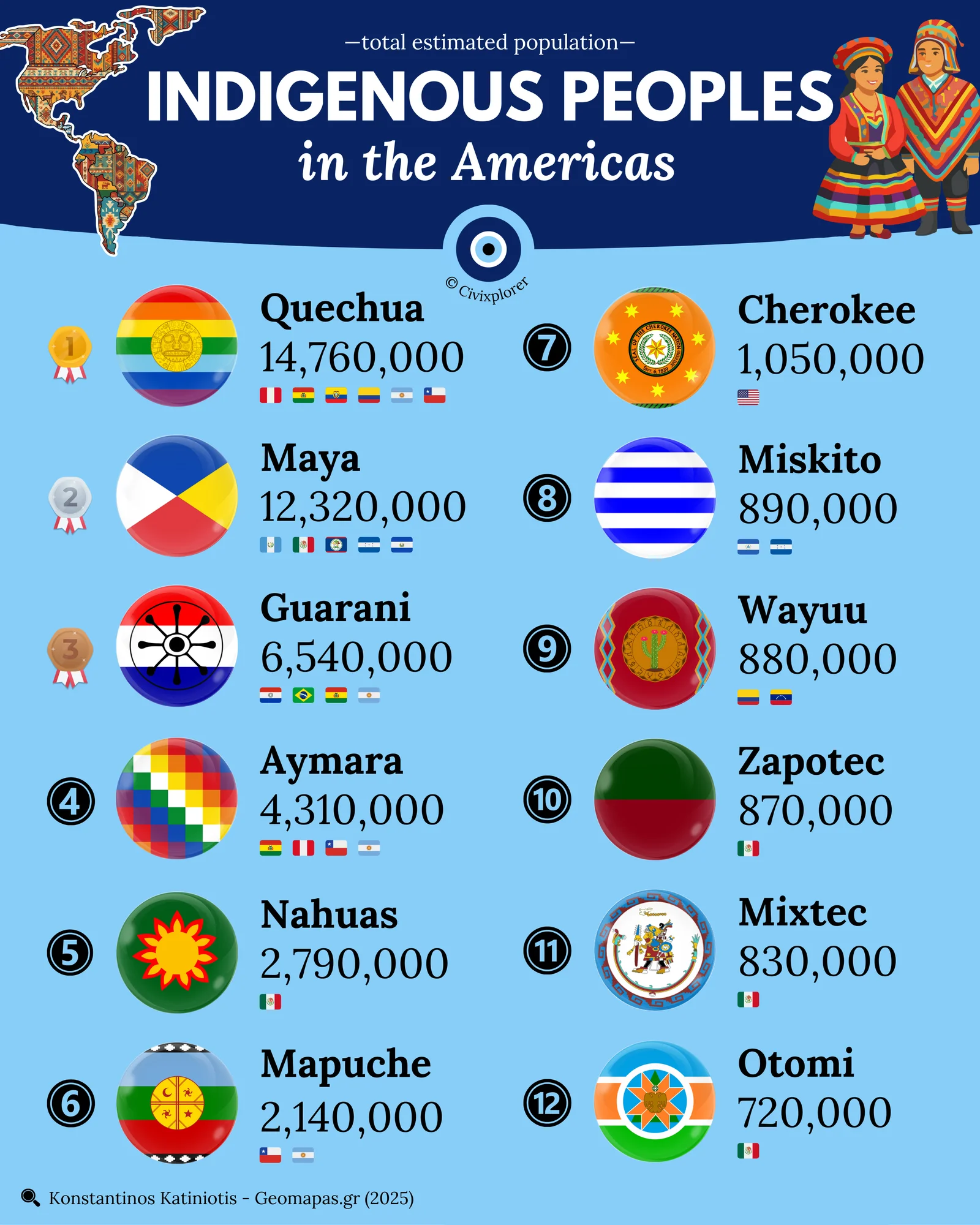
Long before modern borders and colonization, the Americas were home to a rich mosaic of Indigenous civilizations. Today, despite centuries of displacement and cultural suppression, many of these peoples remain vibrant, resilient, and demographically significant. While often perceived as minority populations, groups like the Quechua and Maya represent nations of millions, rivaling the total populations of countries like Belgium or Sweden.
The legacy of pre-Columbian empires is the primary driver of modern demographics in the Andes and Mesoamerica. The Quechua and Aymara peoples are the demographic anchors of the Andes, with nearly 15 million Quechua speakers reflecting the enduring footprint of the Inca Empire. Similarly, Mesoamerica is heavily represented by the descendants of the Aztec and Maya civilizations. The "Maya" umbrella actually comprises roughly 30 distinct languages, highlighting an incredible civilizational diversity across Guatemala and Southern Mexico.
Unique socio-political phenomena also shape these numbers. In Paraguay, the Guarani represent a unique success story where an indigenous tongue has become a national language spoken by the majority of the population, including non-indigenous citizens. In the United States, the Cherokee represent the largest group north of Mexico, a phenomenon driven largely by a surge in self-identification within census data. Meanwhile, the Mapuche in Chile and Argentina stand as a testament to historical resilience, having successfully resisted both Inca and Spanish imperial expansion for centuries.
From the Navajo Nation, which spans a territory larger than ten U.S. states, to the 500 distinct indigenous nations in Brazil, these communities are reclaiming land and asserting their rights in national politics. Understanding the scale and diversity of this presence today is key to understanding the Americas as a whole.
Comments (0)
Join the Conversation
Login to share your thoughts with the community.
Login to Comment