
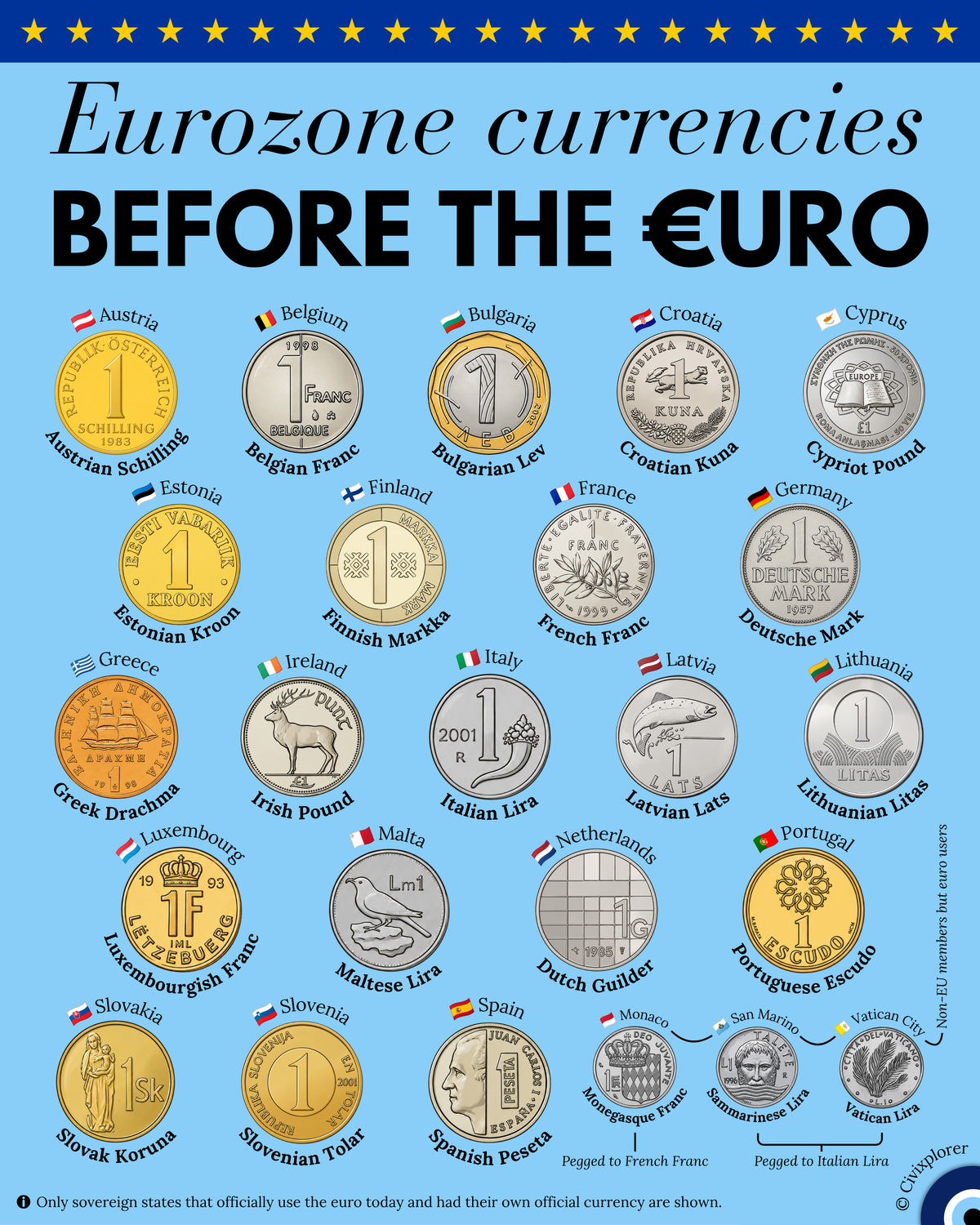
The introduction of the euro represented one of the most significant economic and political shifts in modern European history, transforming the continent from a collection of diverse national symbols into a unified monetary bloc. Before this transition, a country's currency was viewed as a symbol of sovereignty, held in the same regard as a national flag or anthem. The shift toward integration began in earnest on January 1, 1999, when the euro was first introduced as an accounting currency for financial markets and electronic transactions. However, it was not until January 1, 2002, that physical banknotes and coins entered circulation, forever changing daily life for millions of Europeans who saw their marks, francs, and pesetas disappear from their wallets.
The Eurozone was not established all at once but expanded gradually from its eleven founding members in 1999—Austria, Belgium, Finland, France, Germany, Ireland, Italy, Luxembourg, the Netherlands, Portugal, and Spain—to include twenty-one member states by 2026. The most recent addition to this group is Bulgaria, which officially adopted the euro on January 1, 2026. This transition was the culmination of a process that began in 1997 when Bulgaria established a currency board to peg the lev to the Deutsche Mark.
Among the most storied currencies replaced was the German mark (Deutsche Mark), which had become a symbol of West Germany's post-war economic miracle and stability. Many Germans were initially reluctant to abandon the mark because of its deep association with national recovery and the independent policies of the Bundesbank. Similarly, the French franc stood as a testament to French economic independence, undergoing several iterations—including the "new franc" introduced by Charles de Gaulle in 1960—before being replaced at a rate of 6.55957 francs to one euro.
In Southern Europe, the Italian lira and Spanish peseta also held deep cultural significance. The lira was known for its low numerical value, where common items could cost thousands of units, making the transition to the euro a striking psychological change for Italians. In Spain, the peseta, which had existed since 1868, remains so culturally ingrained that many older citizens still mentally convert prices back to the old currency decades later.
The transition also included unique cases involving European microstates like Monaco, San Marino, and Vatican City. Although not members of the European Union, these states use the euro through special monetary agreements because their previous currencies—the Monegasque franc and the Sammarinese and Vatican liras—were historically pegged to the currencies of their larger neighbors. Notably, Andorra is often excluded from such visual archives because it never possessed a sovereign national currency, relying instead on the de facto use of the French franc and Spanish peseta.
The motivations behind abandoning national currencies were both economic and political. A single currency eliminated exchange rate risks for businesses, encouraged cross-border investment, and made tourism and price comparisons significantly easier across the continent. Politically, it was viewed as a way to foster deeper integration and make conflict between European states less likely following the devastation of the world wars. Despite its success, the euro has faced criticism, particularly during the Eurozone debt crisis, when the lack of independent monetary policy made it difficult for struggling economies to regain competitiveness through devaluation. Today, the Eurozone continues to be a diverse landscape, as countries like Denmark and Sweden maintain their own currencies, while others in Eastern Europe continue to weigh the economic and political implications of future adoption.


Comments (0)
Join the Conversation
Login to share your thoughts with the community.
Login to Comment