
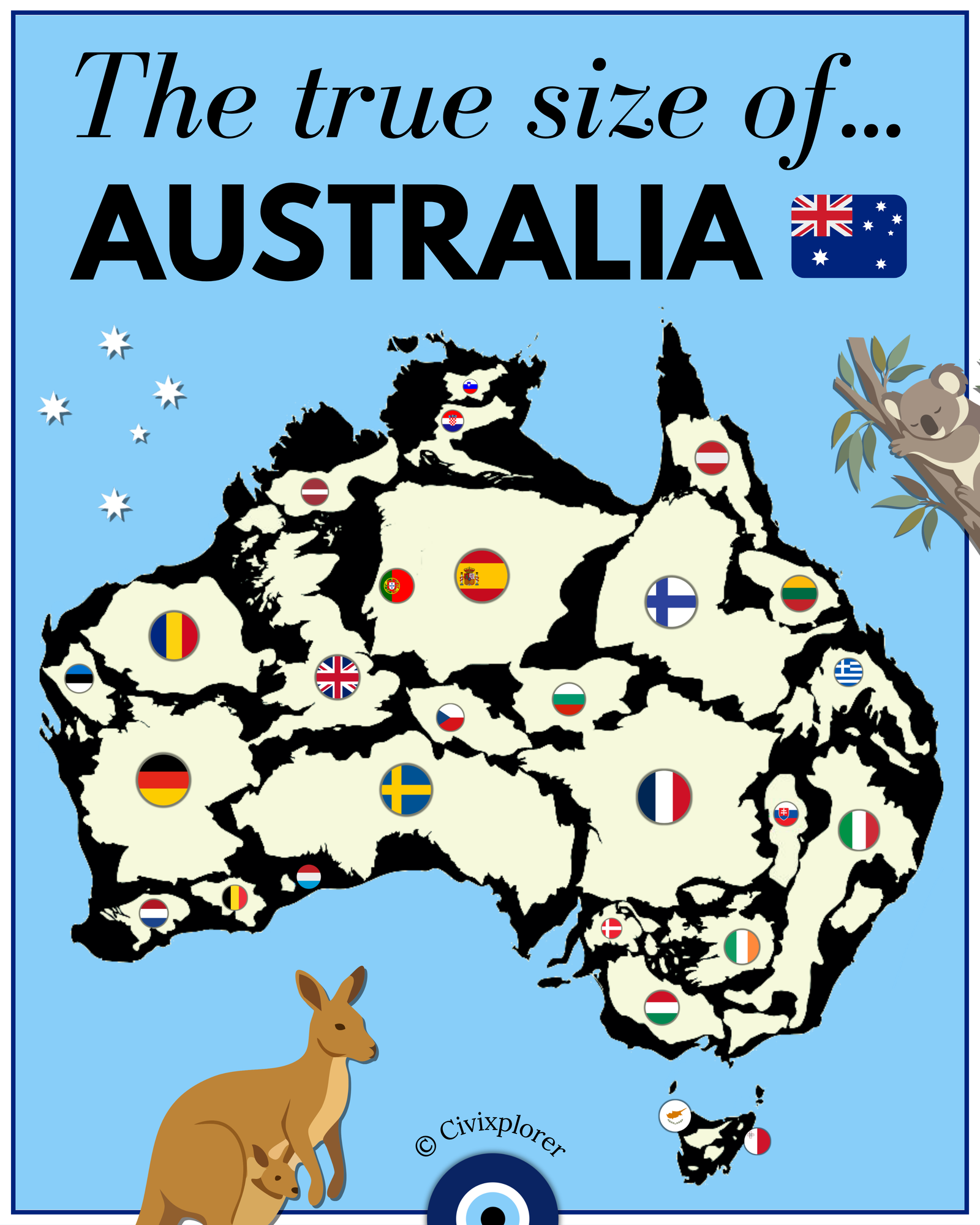
The visual representation of dozens of European nations fitting comfortably inside the silhouette of Australia is more than just a clever graphic; it is a profound lesson in geographic scale. While standard world maps often lead us to believe that Europe is a massive landmass dominating the northern hemisphere, the reality of 7.69 million square kilometers tells a different story.
The primary reason for our skewed perception is the Mercator projection. Originally designed for nautical navigation, this map style distorts the size of landmasses as they move further from the equator. Because Europe sits relatively far north, it appears significantly larger than it is in terms of actual surface area. Australia, being closer to the equator, is often shrunk by comparison. When the distortion is removed, we see that Australia is the world’s sixth-largest country and the only nation that occupies an entire continent.
Despite its massive size, Australia presents a fascinating livability paradox. The continent houses approximately 27 million people, a population smaller than that of individual European countries like Spain or Poland. This discrepancy is driven by the harsh geography of the Outback. The interior is an incredibly arid, sun-baked desert lacking the river systems that allowed Europe to become so densely populated. Consequently, nearly 90% of the population clings to the temperate coastal fringes, leaving the vast interior with one of the lowest population densities on Earth.
This "tyranny of distance" has forced unique societal adaptations. To manage such immense, empty spaces, Australians developed the Royal Flying Doctor Service for airborne healthcare and road trains—massive transport trucks pulling multiple trailers—to move goods across the desert. Even the biodiversity evolved in isolation, creating a world of its own where marsupials like kangaroos and koalas thrive in landscapes that range from tropical beaches to snowy mountains that actually receive more snow than the Swiss Alps.
Comments (0)
Join the Conversation
Login to share your thoughts with the community.
Login to Comment