
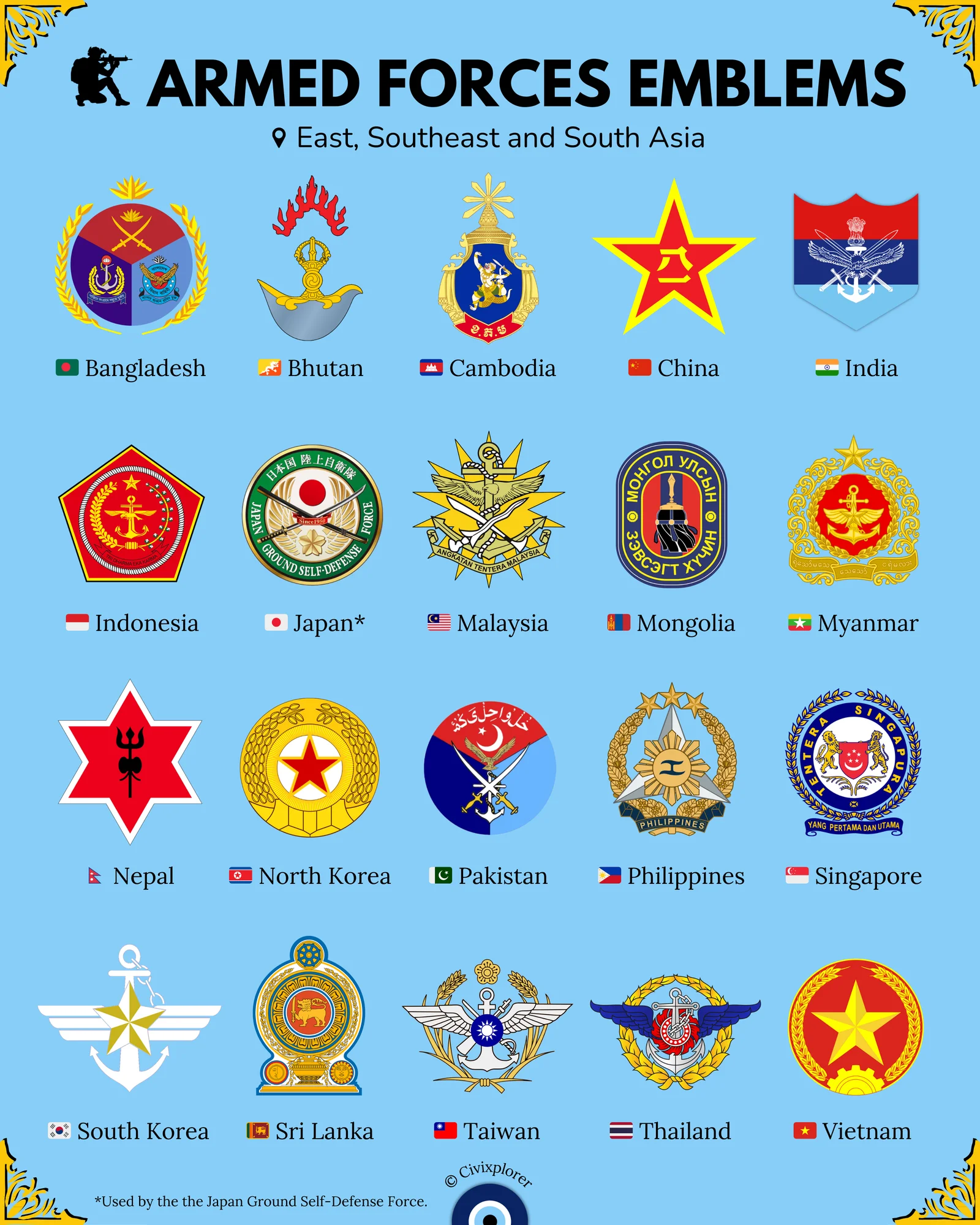
Armed forces emblems serve as a visual shorthand for a nation’s history, political ideology, and geographic reality. Across East, Southeast, and South Asia, these designs are far more than just military identifiers; they represent a complex tapestry of tradition, revolution, and regional identity.
A recurring theme across many of these nations is the "Tri-Service" motif. Emblems from countries like India, Pakistan, Bangladesh, and Taiwan integrate the three main branches of defense into a single unified symbol. Typically, the anchor represents the Navy, the crossed swords represent the Army, and the wings represent the Air Force. By layering these elements, the emblems communicate a comprehensive and unified national defense strategy.
Political ideology also plays a defining role in military iconography. The use of the five-pointed star and the color red is prominent in the emblems of China, North Korea, and Vietnam. In these contexts, the star is not merely decorative; it is a symbol of the revolutionary struggle. China’s emblem specifically commemorates the Nanchang Uprising of 1927 with the characters for "August 1," marking the birth of the People's Liberation Army.
Beyond politics, cultural and religious heritage often takes center stage in these designs. Bhutan incorporates the Dharma Wheel, reflecting its deep ties to Vajrayana Buddhism, while Nepal utilizes the trident of Lord Shiva to emphasize its Hindu heritage. Thailand features the Garuda, a divine creature from Hindu and Buddhist mythology that serves as a symbol of the monarchy. Japan’s Ground Self-Defense Force emblem features the Sakura, or cherry blossom, symbolizing the transient nature of life and the spirit of the Samurai.
Finally, post-colonial identity is evident in how nations have transitioned from inherited traditions to new national identities. India’s emblem features the Ashoka Lion Capital from the ancient Mauryan Empire, signaling a connection to a pre-colonial past. Similarly, Pakistan incorporates the crescent and star, the foundational identity of the state. These emblems are a testament to how nations honor their heritage while defining their place in the modern world.
Comments (0)
Join the Conversation
Login to share your thoughts with the community.
Login to Comment