
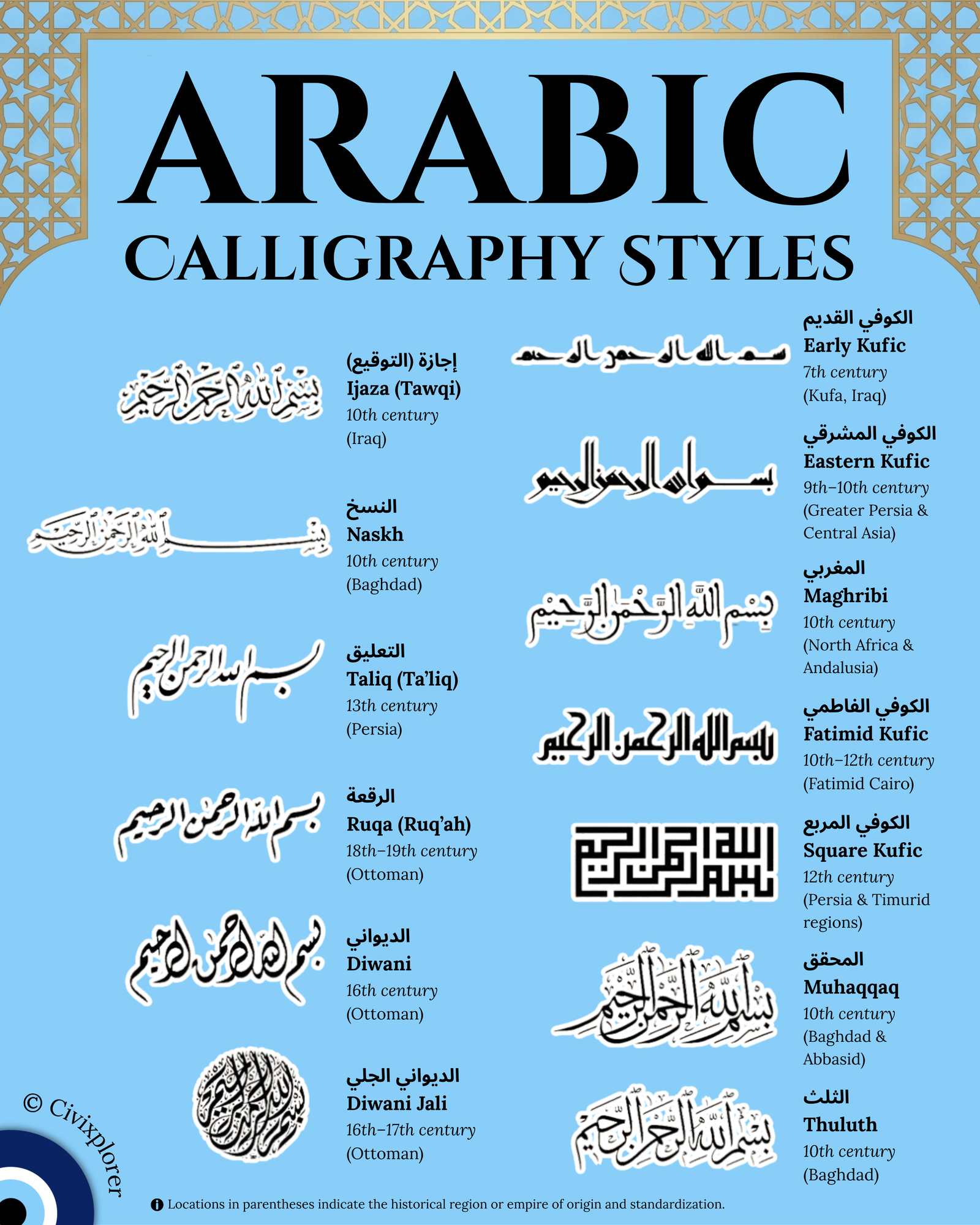
Arabic calligraphy is not merely a collection of aesthetic "fonts"; it is a historically layered tradition that functions as a visual map of Islamic culture, faith, and administrative history. Emerging in the 7th century CE, the primary driver for its development was the urgent need to preserve the Quran with precision and beauty. Over centuries, this art form has evolved from rigid, angular scripts used on stone and parchment to sophisticated, mathematical systems that continue to influence modern graphic design and digital typography today.
The Kufic Foundation and Regional Variants
The earliest formalized style is Early Kufic, which originated in the 7th century in the Iraqi city of Kufa. Its bold, geometric rigor and heavy horizontals made it ideal for monumental inscriptions, coins, and early Quranic manuscripts. From this foundation, several regional variants emerged to suit local aesthetics and materials. Eastern Kufic (9th–10th century) became more elongated and decorative as it moved into Persia, while Maghribi (10th century) developed in North Africa and Islamic Spain, featuring softer, sweeping curves produced by local reed pens. Square Kufic (12th century) represents a peak of geometric innovation, treating letters like pixels in a grid to integrate sacred phrases seamlessly into architectural tilework and brick-built patterns.
The Cursive Revolution and the "Six Pens"
A pivotal turning point in calligraphic history occurred in 10th-century Baghdad under the master calligrapher Ibn Muqla. He revolutionized the art by introducing a mathematical system of proportions based on the rhombic dot, moving calligraphy from rigid angularity toward fluid, cursive forms. This system led to the codification of the "Six Pens," which established the rules for classical training. Key among these is Naskh, which became the workhorse script for scholarly texts and the foundation of modern Arabic printing due to its clarity. In contrast, Thuluth developed as a majestic, sweeping script reserved for mosque decorations, architectural titles, and religious inscriptions. Mohaqqaq also belongs to this prestigious era, known for its bold, "perfected" strokes in grand manuscripts across the Mamluk and Ilkhanid empires.
Regional Innovations and Ottoman Mastery
As the Islamic world expanded, regional bureaucratic and literary needs birthed new styles. Taliq emerged in the 13th century under Persian influence, featuring a slanted, "hanging" rhythm designed for poetry and official correspondence. Later, the Ottoman Empire refined these traditions into highly specialized scripts at its chancery in Istanbul. Diwani (16th century) was created specifically for the imperial council; its complex, densely interlaced letters were intentionally difficult to forge, serving both the security needs of royal decrees and the aesthetic grandeur of the court. For everyday utility, Ottoman calligraphers standardized Ruqa (18th–19th century), a quick and legible script that remains the ancestor of much contemporary informal Arabic handwriting today.
Today, these diverse styles are recognized by UNESCO as intangible cultural heritage, representing a continuous dialogue between spiritual devotion, imperial power, and artistic innovation.
Comments (0)
Join the Conversation
Login to share your thoughts with the community.
Login to Comment