
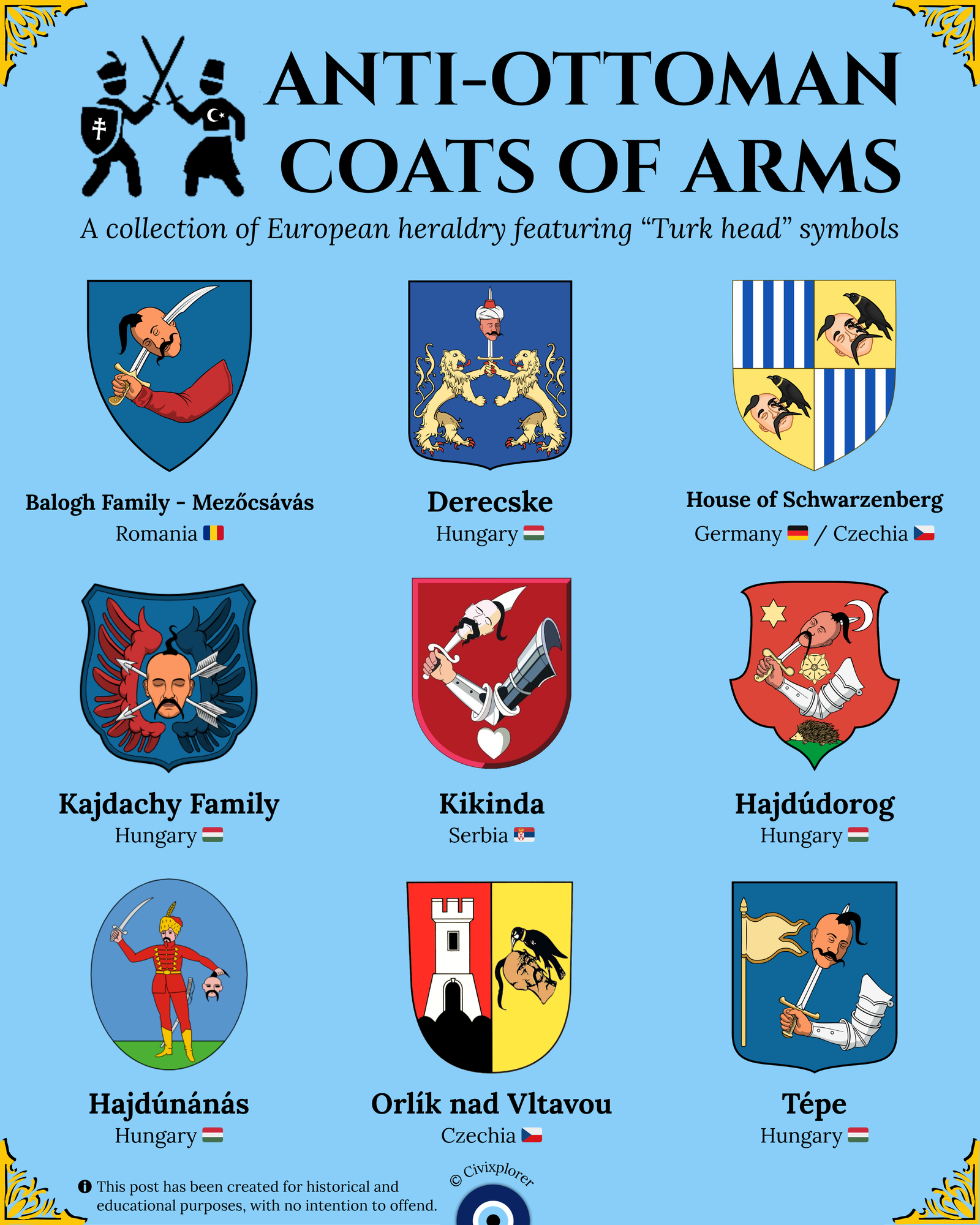
Between the 15th and 18th centuries, the geopolitics of Europe were defined by the aggressive expansion of the Ottoman Empire into the Balkans, Hungary, and Central Europe. For the Kingdom of Hungary and the Habsburg Monarchy, this era was an existential struggle characterized by constant raids, sieges, and intense brutality. This high-stakes environment led to the creation of a unique and visually striking form of heraldry that remains visible across Central and Eastern Europe today.
The "Turk head" (caput Turcae) became a standard heraldic charge, typically featuring a stylized severed head with a scalp lock and prominent mustache. These gruesome symbols were not meant to be generic imagery but were specific rewards granted by monarchs to nobles, mercenaries, or towns that displayed exceptional bravery or secured major victories against Ottoman forces. In this context, the motif served as the ultimate badge of honor, signifying the bearer as a "bulwark of Christendom" and a defender of their homeland.
One of the most famous examples is the House of Schwarzenberg, whose coat of arms features a raven pecking at the eye of a severed head. This specific addition was awarded in 1598 after Adolf von Schwarzenberg recaptured the strategic fortress of Győr. In a clever heraldic pun, the German name for the fortress, "Raab," sounds like "Rabe," which means raven. Similarly, the "Hajdú" towns of Hungary, such as Hajdúnánás and Hajdúdorog, use this imagery to reflect their history as fierce, independent frontier warriors who were granted noble privileges in exchange for their military service.
In modern times, these symbols persist in official municipal arms, such as in Kikinda, Serbia, where an arm with a sabre impaling a head celebrates the town's role as a frontier guard. While these graphics can feel jarring to modern sensibilities, they represent a shared cultural memory of survival and triumph during centuries of brutal conflict. They serve as a vivid illustration of how the history of warfare and the preservation of European borders left a lasting mark on the visual identity of the region.
Comments (0)
Join the Conversation
Login to share your thoughts with the community.
Login to Comment