
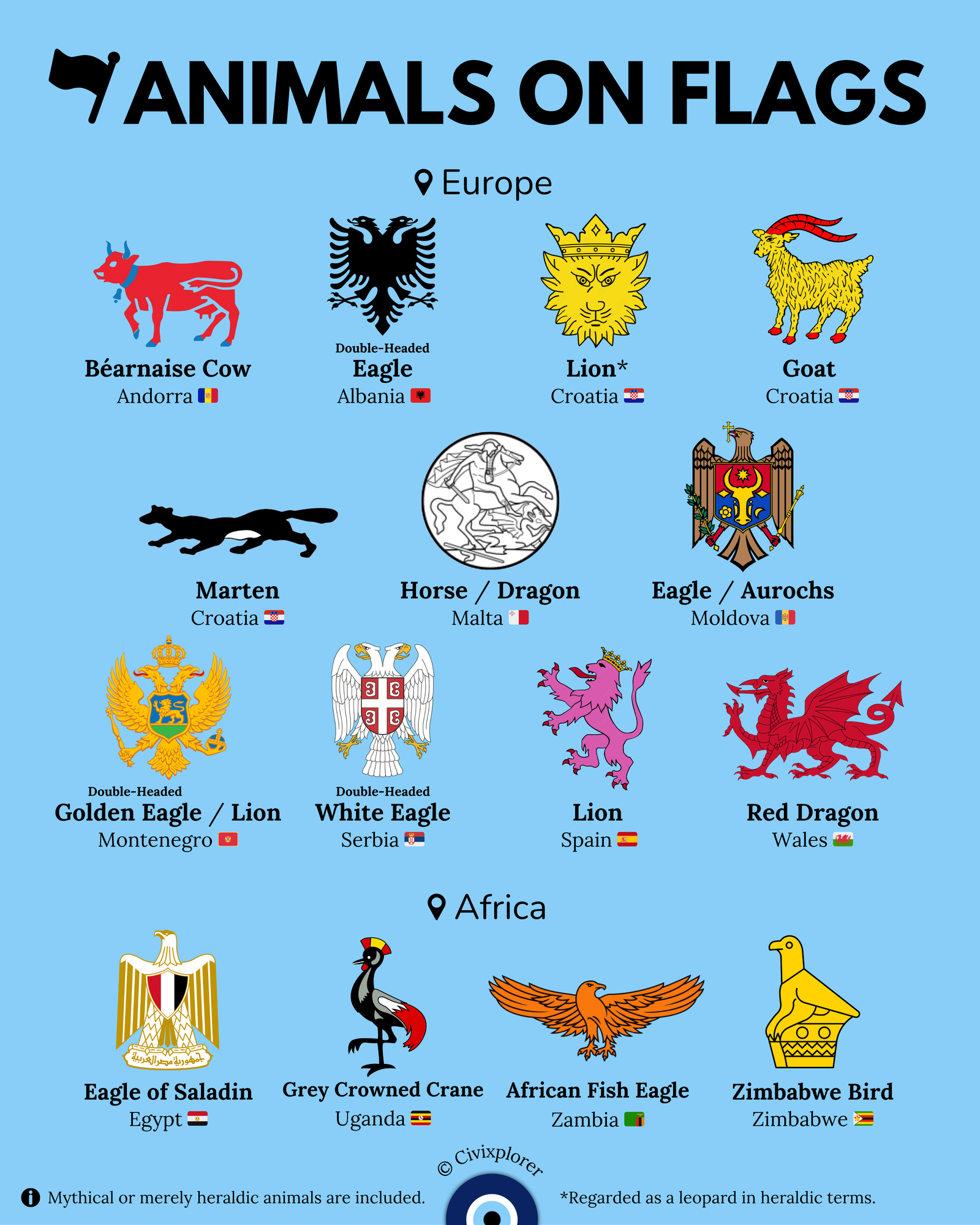
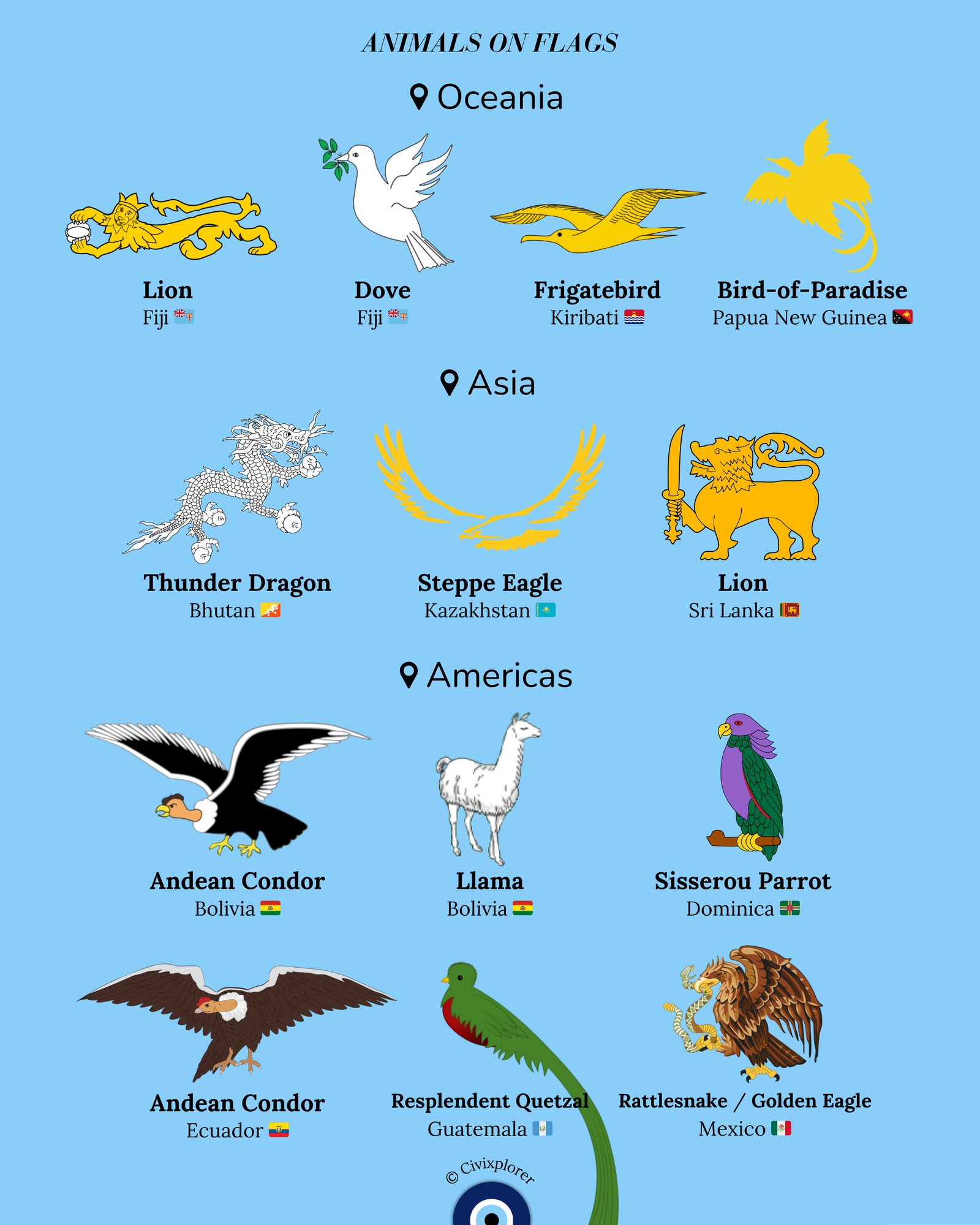
Across the globe, national flags serve as more than just a canvas of colors; they are living history books that weave together mythology, power, and natural heritage. While some animals appear purely decorative, their presence often captures a country’s ancient foundation myths, colonial past, or deep connection to its native ecology.
The Divide: Feudal Heraldry vs. Natural Biodiversity
One of the most striking patterns in vexillology—the study of flags—is the contrast between European designs and the rest of the world. European flags are heavily dominated by medieval heraldry. Animals like lions and dragons were adopted from ancient coats of arms to project royalty and ferocity rather than to reflect local wildlife. For instance, the lion on the Spanish flag represents the historic Kingdom of León, while the Red Dragon of Wales is rooted in ancient Roman-British military standards and Arthurian legend.
In contrast, nations in the Americas, Africa, and Oceania frequently choose endemic species to celebrate their natural wealth and landscape. The Andean Condor in Bolivia and Ecuador, the Resplendent Quetzal in Guatemala, and the Bird-of-Paradise in Papua New Guinea serve as proud reflections of the local environment and symbols of freedom rather than dynastic lineage.
Imperial Legacies and Founding Myths
The Double-Headed Eagle seen in nations like Albania, Montenegro, and Serbia is a direct historical legacy of the Byzantine Empire, traditionally representing dual sovereignty over both the East and the West.
Other animals represent literal founding myths that define a nation's soul. The Mexican flag features an eagle perched on a prickly pear cactus eating a snake, a scene based on the Aztec legend of the founding of Tenochtitlan. In Bhutan, the Thunder Dragon (Druk) is so central to their identity that the country’s local name, Druk Yul, translates to "Land of the Thunder Dragon." The dragon embodies purity, while the jewels it holds signify wealth and perfection.
Vexillological Quirks and Colonial Ties
Some flags tell unique stories of economic and political shifts. Croatia’s flag features a menagerie including a marten (kuna), an animal whose pelts were used as medieval tax payments, eventually giving the name to the country's national currency for decades.
In Fiji, a British heraldic lion holds a cocoa pod, a fascinating blend of imperial symbols and local agriculture. Similarly, the Zimbabwe Bird is modeled on 800-year-old soapstone carvings unearthed at the medieval city of Great Zimbabwe, linking modern independence directly to a pre-colonial powerhouse.
Whether through the fierce tail of a dragon or the iridescent feathers of a Quetzal, these animals foster national unity and pride, reminding us that every flag is a story of feathers, fur, and fire-breathing legends.
Comments (0)
Join the Conversation
Login to share your thoughts with the community.
Login to Comment