
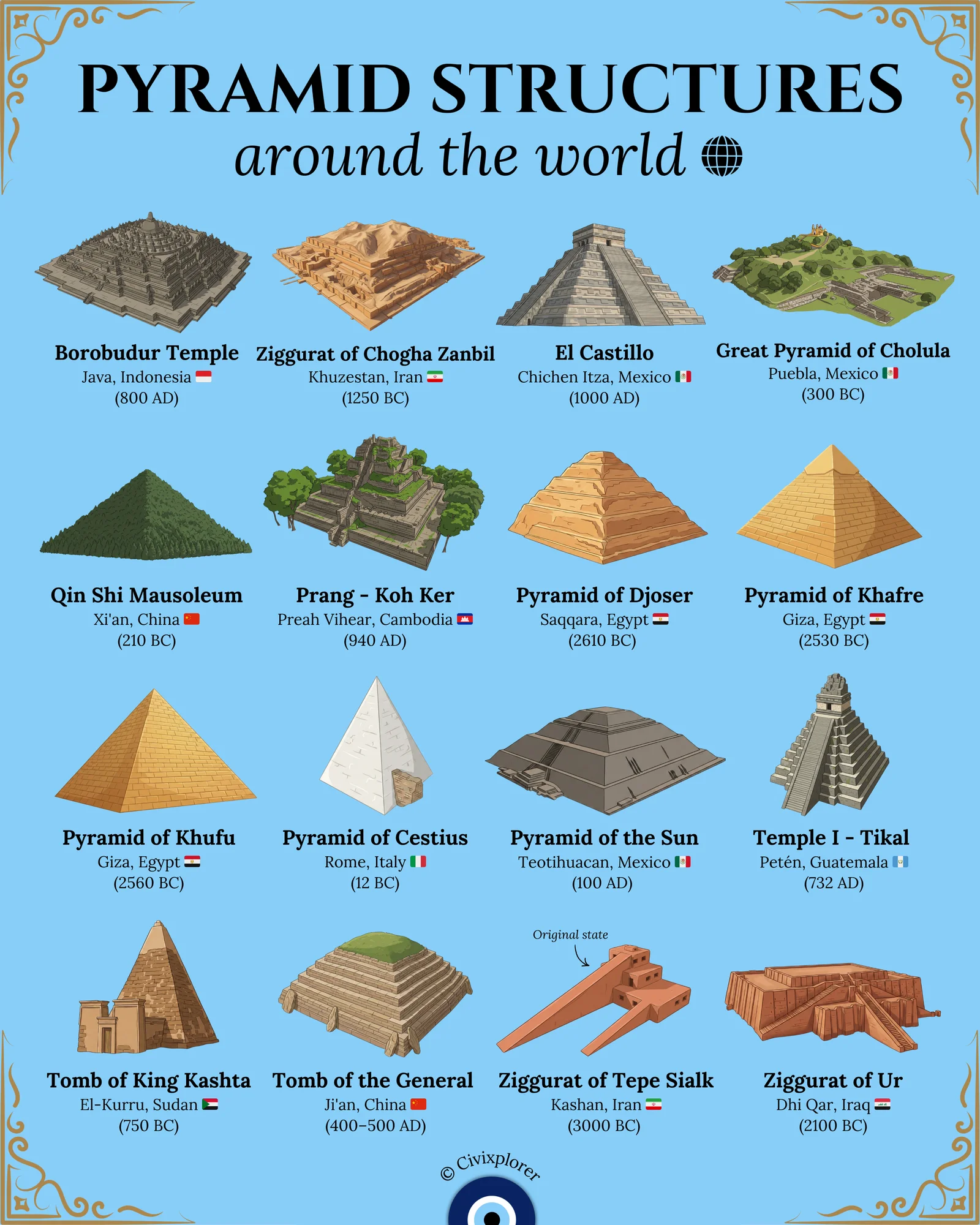
The world’s landscape is dotted with monumental structures that, despite being separated by thousands of miles and different eras, share a striking geometric commonality: the pyramid. This phenomenon serves as a fascinating visual map of convergent evolution in architecture. While popular theories often suggest outside intervention, the reality is rooted in the fundamental laws of physics. In an age before steel beams and reinforced concrete, the pyramid was the most stable way to build toward the heavens. By distributing the weight of the structure toward a wide base, ancient engineers could achieve massive heights without the risk of collapse. It is, quite literally, the natural angle of repose rendered in stone.
Beyond the shared physics, these structures served diverse and distinct purposes across various civilizations. In regions like Egypt, Sudan, and China—home to the Qin Shi Mausoleum—pyramids functioned primarily as "eternal houses" or tombs designed to protect the deceased and their treasures. Conversely, in Mesopotamia and Mesoamerica, these were often elevated platforms for the gods. Ziggurats and structures like El Castillo or Tikal were essentially stairways to heaven, built to support temples at the summit where priests could perform rituals closer to the sky.
History also reveals unique outliers that challenge our standard perceptions. For instance, the Great Pyramid of Cholula in Mexico is actually the largest pyramid in the world by volume, yet it is often mistaken for a natural hill because it is largely overgrown. In Rome, the Pyramid of Cestius stands as a testament to cultural trends, built during a period of Roman obsession with Egyptian aesthetics. Further south in Sudan, the Nubian pyramids show a distinct local "flavor" with much steeper and narrower designs compared to their Giza counterparts. From the Buddhist cosmology reflected in the tiers of Indonesia’s Borobudur Temple to the mud-bricks of Iraq, these structures represent independent human triumphs of engineering and the enduring desire to touch the sky.
Comments (0)
Join the Conversation
Login to share your thoughts with the community.
Login to Comment