
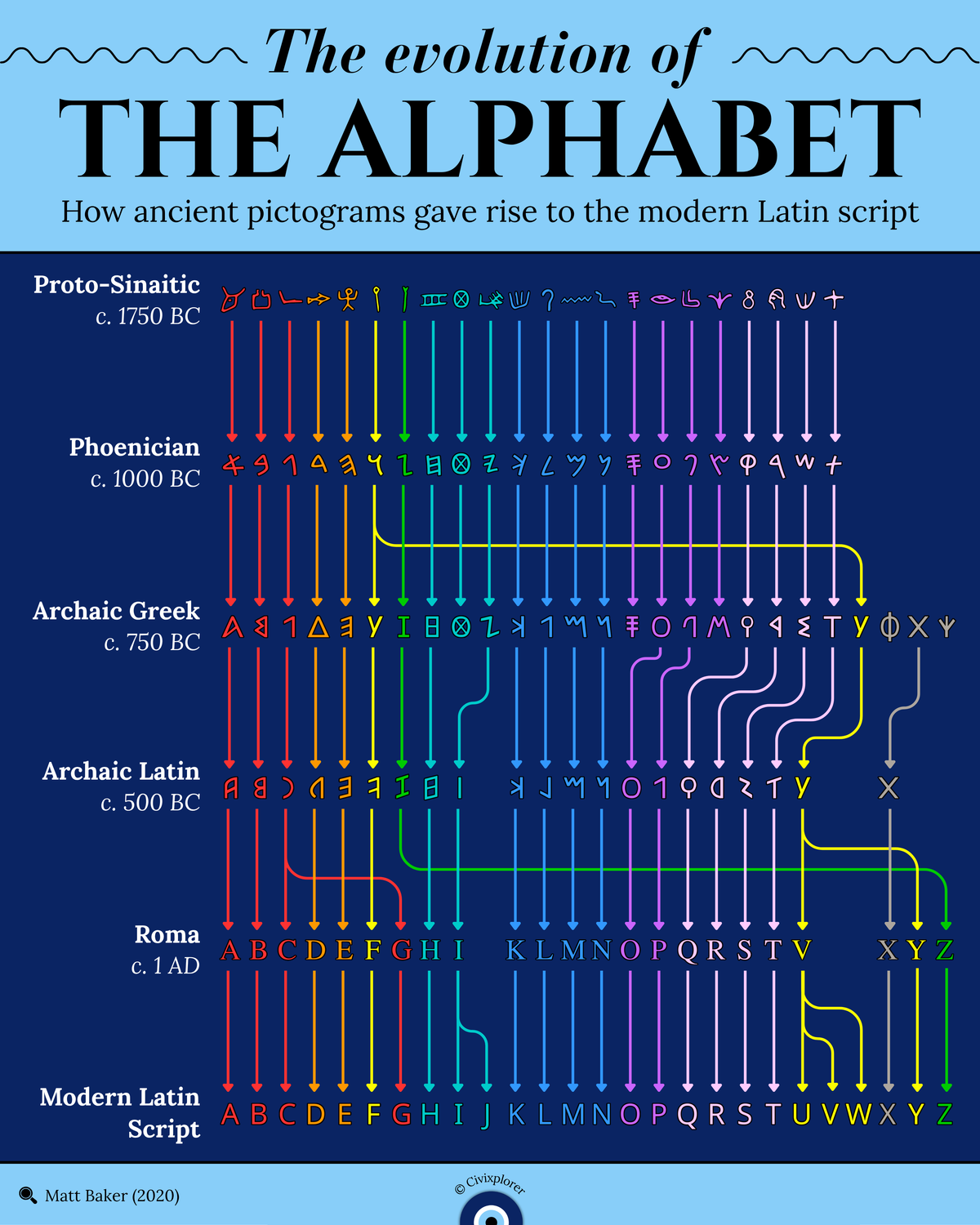
The journey of the modern Latin script is a fascinating 4,000-year linguistic odyssey that traces the transformation of ancient Afro-Asiatic pictograms into the abstract phonetic symbols we use today. This evolution is not merely a timeline of changing shapes but a narrative of cultural exchange, phonological problem-solving, and practical adaptation that fundamentally democratized literacy.
Around 1750 BC, Semitic workers and soldiers in the Sinai Peninsula developed what is now known as the Proto-Sinaitic script. Rather than mastering the complex Egyptian hieroglyphic system, these individuals applied the acrophonic principle. They took recognizable Egyptian icons and used them to represent only the initial sound of the Semitic word for that object. For instance, the word for ox was aleph; consequently, a simple drawing of an ox head became the symbol for the glottal stop consonant. Similarly, a floorplan of a house (bayt) became the ancestor of the letter B.
By 1000 BC, the Phoenicians, a civilization of maritime merchants, standardized these symbols into a linear, abstract script. Their system was an abjad, containing only consonants, and was typically written from right to left. As these merchants traded across the Mediterranean, their efficient 22-letter system spread, eventually reaching the Greeks.
The Greek innovation around 750 BC marked the single most consequential functional change in the history of the alphabet. Because the Greek language relied heavily on vowels, the Phoenician abjad was insufficient. The Greeks brilliantly repurposed Phoenician consonants that represented sounds not found in Greek—such as the glottal stop—and transformed them into dedicated vowel letters like Alpha, Epsilon, and Omicron. This created the first true alphabet where both consonants and vowels were systematically represented. It was also during this period that the direction of writing shifted to left-to-right, causing many asymmetrical letters like B, E, and K to be flipped to face their modern orientation.
The script reached the Romans via the Etruscans in Italy around 500 BC. This transition introduced several unique quirks. For centuries, the letter C served for both "g" and "k" sounds until a Roman freedman added a horizontal stroke to create the letter G. The letters Y and Z were actually late additions, re-imported from Greece after Rome conquered the region in the 1st century BC to help spell foreign loanwords accurately.
The final evolution into the 26-letter modern script occurred during the Middle Ages and the Renaissance. Letters that we view as distinct today, such as I and J or U and V, were originally typographic variations of the same characters. It wasn't until the 16th century that printers and grammarians standardized their use to distinguish between vowels and consonants. The letter W emerged even later as Germanic languages required a way to represent a sound that classical Latin had lost, literally resulting in a "double-U."
Today, the Latin alphabet is a global standard, connecting modern technology to ancient Sinai miners through a continuous chain of adaptation. Every time we type the letter A, we are unknowingly rendering a highly stylized, upside-down version of an ancient ox head.

Comments (0)
Join the Conversation
Login to share your thoughts with the community.
Login to Comment