
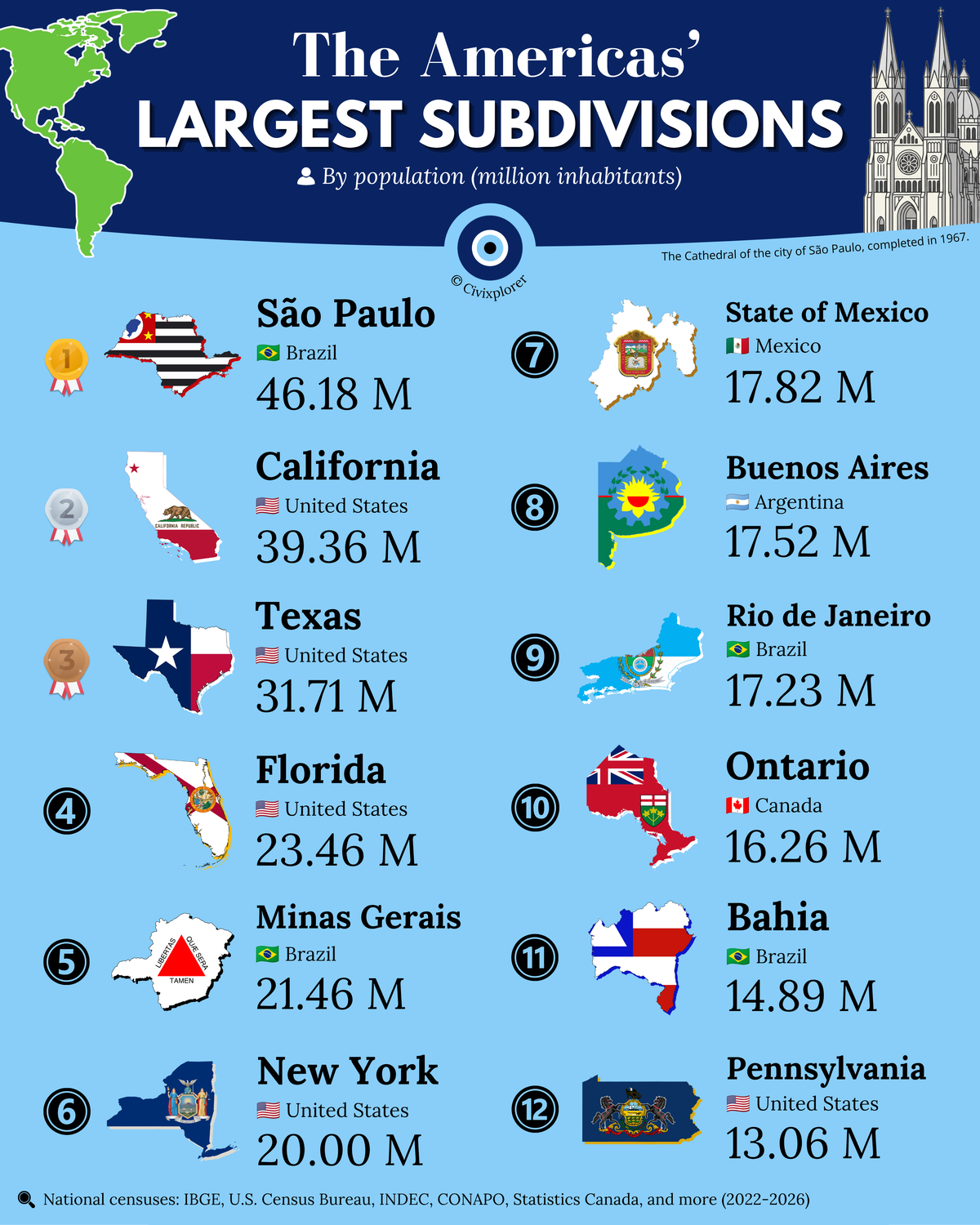
Across the Western Hemisphere, national demographics are heavily defined by internal administrative borders that concentrate tens of millions of inhabitants within single states or provinces. The top twelve most populous first-level subdivisions in the Americas collectively hold over 250 million people, forming massive demographic and economic powerhouses whose populations often surpass entire sovereign nations. Understanding these subnational territories requires distinguishing between a primary municipality, a wider metropolitan area, and the full administrative state or province. From agricultural and industrial hubs in South America to rapid population shifts in North America, these regional territories illustrate how urbanization, migration corridors, and historical settlement patterns shape the modern Americas.
Standing at the absolute peak of the ranking is São Paulo, Brazil, with an overwhelming 46.18 million residents. Driven historically by the nineteenth-century coffee boom, extensive international immigration, and subsequent industrial expansion, São Paulo evolved from a peripheral area into an economic titan that generates roughly 31.5% of Brazil's total GDP. Its total population is nearly four times larger than its capital municipality alone, showcasing an extensive urban network that stretches far beyond the city limits. Brazil's continental scale is further highlighted by three other major states in the ranking: Minas Gerais with 21.46 million residents, Rio de Janeiro with 17.23 million, and Bahia with 14.89 million, which together demonstrate how demographic weight is distributed across coastal and inland territories.
In North America, the United States accounts for five entries, reflecting major structural shifts between long-established industrial centers and rapidly growing southern regions. California holds the second spot overall with 39.36 million inhabitants, maintaining its position as the most populous U.S. state due to decades of technological innovation, agricultural output, and global trade, even as its recent population trajectory has remained relatively flat. Meanwhile, Texas ranks third with 31.71 million residents and Florida ranks fourth with 23.46 million, both experiencing rapid expansion driven by economic opportunities, net domestic migration, and vibrant metropolitan corridors. Rounding out the U.S. presence are New York at 20.00 million and Pennsylvania at 13.06 million, both representing historic economic gateways whose total state figures extend well beyond their primary urban centers.
Beyond Brazil and the United States, the ranking reveals unique geographic dynamics through urban spillover and extreme population concentration. The State of Mexico ranks seventh with 17.82 million residents, while Buenos Aires Province in Argentina ranks eighth with 17.52 million. Neither subdivision contains its national capital city; instead, both encircle autonomous federal entities—Mexico City and the Autonomous City of Buenos Aires—absorbing decades of massive suburban expansion and metropolitan growth across administrative boundaries. Finally, Canada's sole entry, Ontario, ranks tenth with 16.26 million residents. Supported by the Greater Toronto Area's economic engine, Ontario concentrates nearly 40% of Canada's total population within its southern economic corridor, illustrating how subnational divisions can anchor an entire nation's demographic landscape.

Comments (0)
Join the Conversation
Login to share your thoughts with the community.
Login to Comment