
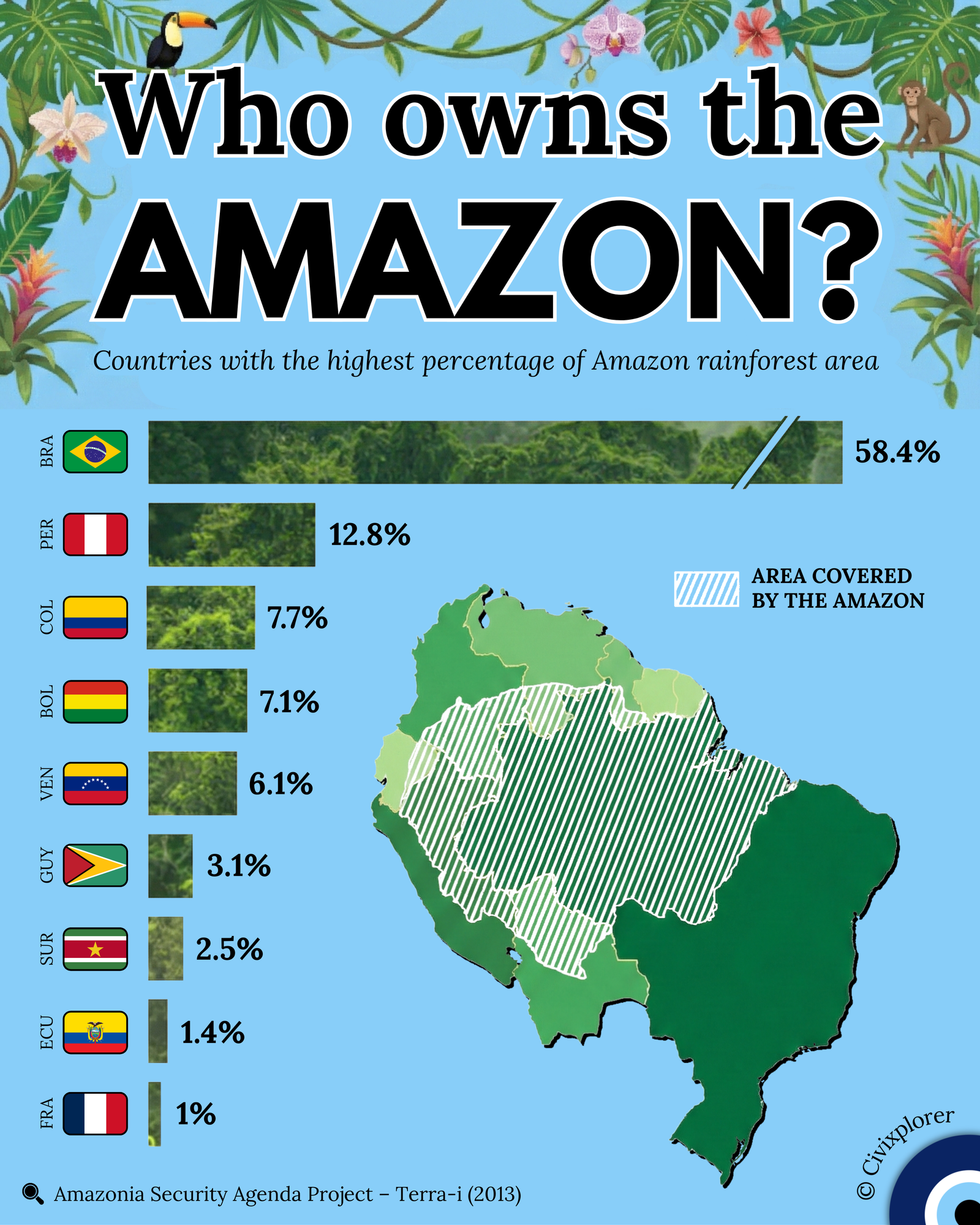
The Amazon rainforest is often perceived as a monolithic entity, but it is actually a vast geopolitical puzzle shared across nine sovereign borders. This transboundary lifeline covers approximately 40% of South America, functioning as a critical global carbon sink and a regulator of regional climates. Because the rainforest operates as a single ecological system, its survival depends on a delicate balance of international cooperation.
Brazil holds the overwhelming majority of the biome, with a 58.4% share. This dominance is a result of both geography and colonial history; the Amazon River basin naturally expands most extensively across the northern half of the continent, and historical Portuguese expansion pushed far beyond original colonial boundaries to claim these vast river networks. Consequently, Brazil's domestic environmental policies dictate the fate of the entire ecosystem.
Peru follows with the second-largest portion at 12.8%, located primarily in its eastern lowlands where the forest transitions into the Andean foothills. These regions are recognized as some of the most biodiverse areas on the planet, creating unique evolutionary hotspots. Other nations, including Colombia, Bolivia, and Venezuela, hold significant shares that are vital for both cultural preservation and indigenous land rights.
One of the most intriguing aspects of Amazonian geopolitics is the 1% stake held by France through French Guiana. As an overseas department fully integrated into the French Republic and the European Union, French Guiana represents a European presence in the heart of the tropics. Notably, this means France’s longest international land border is not with a European neighbor, but with Brazil.
Ultimately, the Amazon is not a piece of "owned" property but a shared resource. Protecting it requires collective stewardship through frameworks like the Amazon Cooperation Treaty, as degradation in one nation—whether from mining, cattle ranching, or political instability—inevitably ripples across the entire continent.
Comments (0)
Join the Conversation
Login to share your thoughts with the community.
Login to Comment