
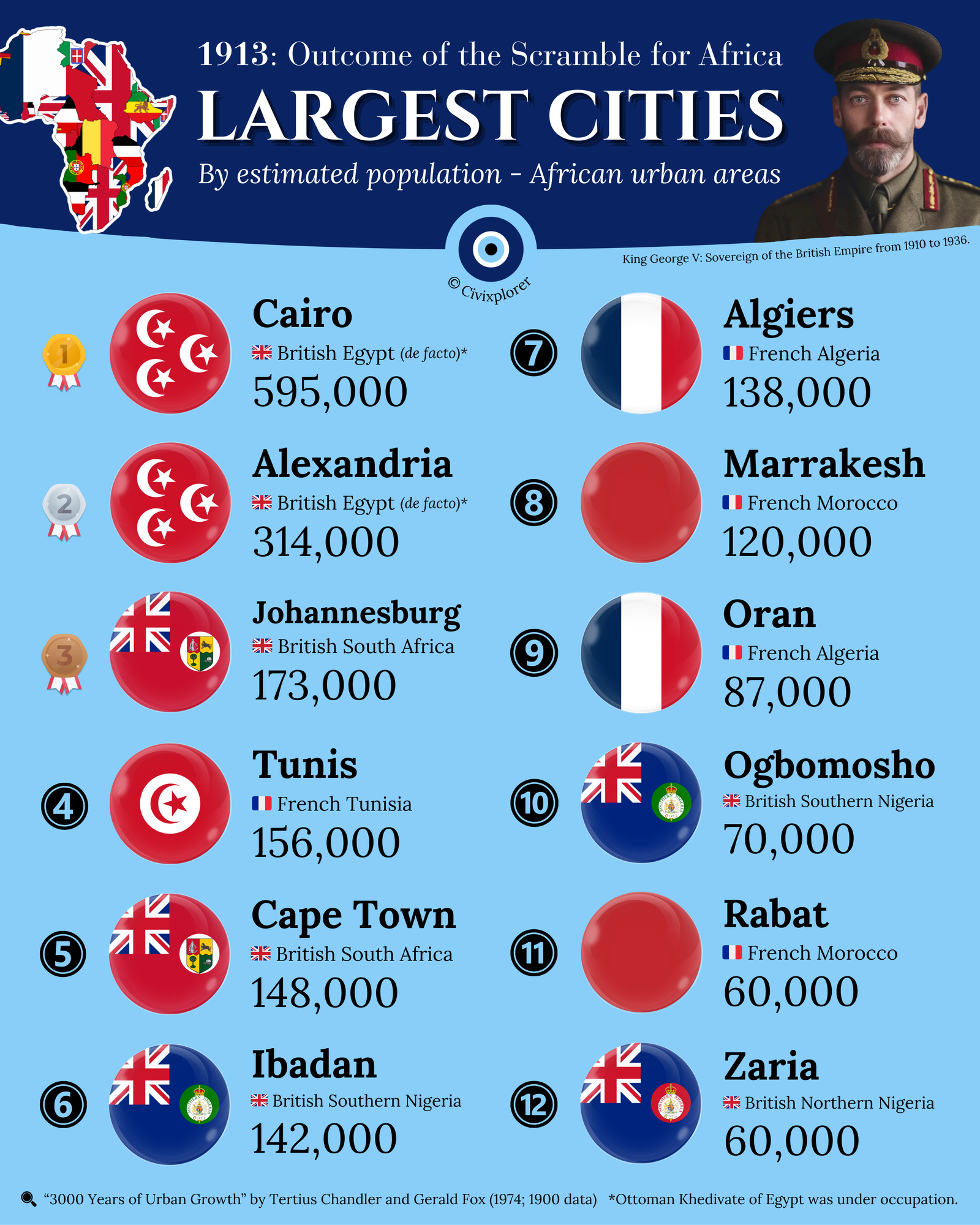
The year 1913 represents a critical snapshot of the African continent, marking the eve of World War I and the effective peak of the "Scramble for Africa". By this time, European powers—primarily Britain and France—had partitioned nearly 90% of the continent, drawing borders that often ignored existing ethnic and political realities. This era of intense imperialism transformed Africa from a mosaic of independent kingdoms into a network of colonial territories driven by a hunger for raw materials and strategic dominance.
The urban hierarchy of 1913 reveals three distinct types of urbanization: ancient Mediterranean hubs, industrial "boomtowns," and indigenous metropolises.
At the top of the list, Cairo and Alexandria represent the "Cape to Cairo" British imperial ambition. These ancient Nile Delta centers boomed under British de facto control, fueled by the agricultural wealth of the region and the strategic importance of the Suez Canal, which opened in 1869. Their massive populations—with Cairo reaching nearly 600,000 residents—dwarfed other continental cities at the time.
In contrast, Johannesburg stands as a symbol of rapid, resource-fueled colonial urbanization. Barely existing thirty years prior, the city exploded into a metropolis following the discovery of gold on the Witwatersrand reef in 1886. Unlike the ancient trade centers of the North, Johannesburg was a gritty industrial hub created purely for resource extraction.
Perhaps most importantly, the data challenges the misconception that all African urbanization was a European import. Cities like Ibadan, Ogbomosho, and Zaria in Nigeria were thriving pre-colonial urban centers. Ibadan, for instance, grew organically in the 1820s as a war camp and refugee center during the Yoruba civil wars, maintaining its status as a cosmopolitan hub long before British annexation.
Finally, the French presence was heavily concentrated in the Maghreb, with cities like Algiers and Tunis serving as Mediterranean outposts. France viewed Algeria as an integral part of its own territory, leading to massive infrastructure investment and a high density of European settlers. Together, these diverse urban centers tell a story of power, resilience, and the complex foundations of modern Africa.
Comments (0)
Join the Conversation
Login to share your thoughts with the community.
Login to Comment