
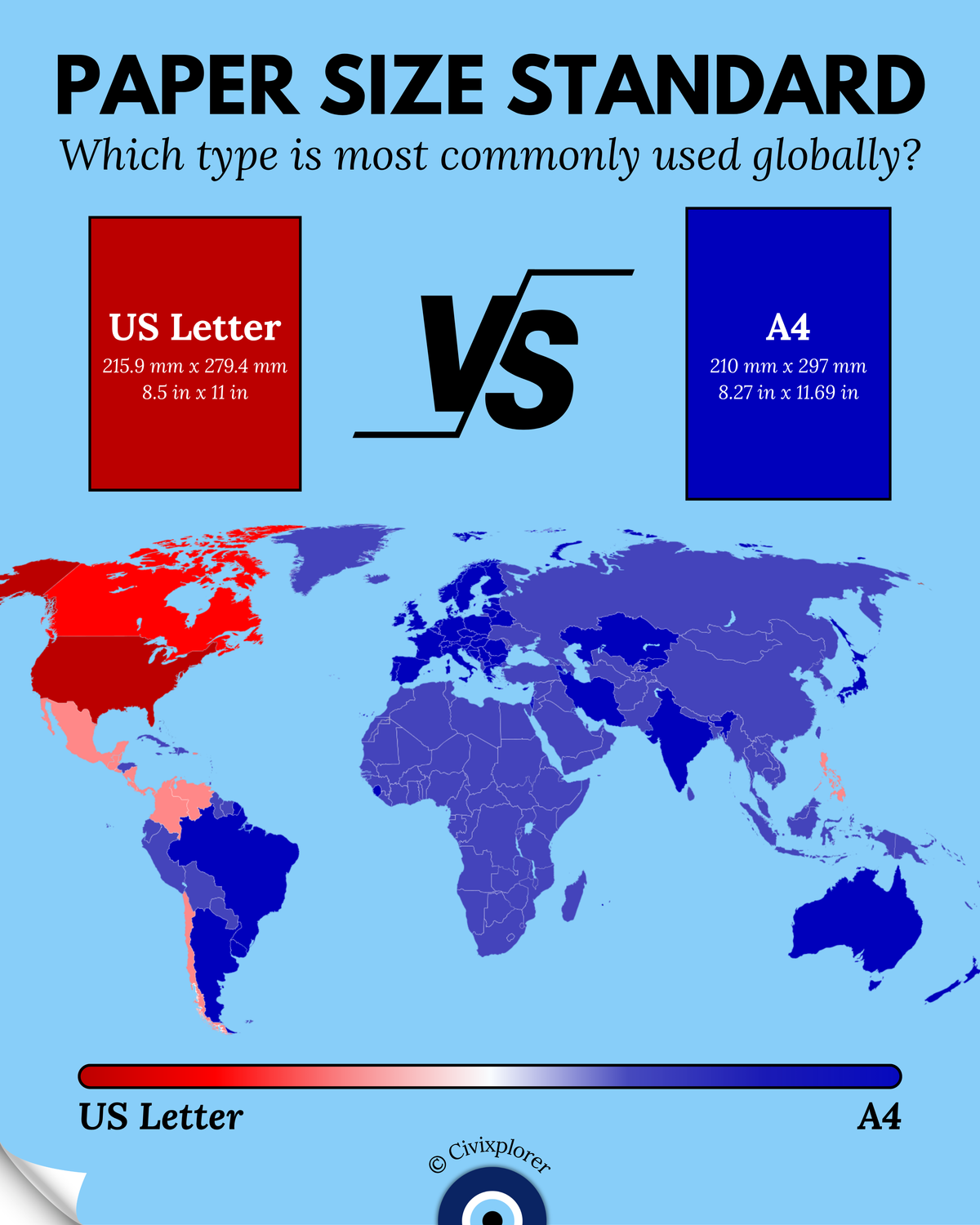
Every day, billions of documents are printed across the globe, yet the stationary inside your printer reveals a fascinating geographic divide that splits North America from the rest of the world. While most people rarely think twice about sheet dimensions, global paper usage is overwhelmingly dominated by two competing standards: the international A4 format and the North American US Letter standard. This regional split highlights how historical traditions, mathematical innovation, and industrial friction shape the everyday tools of global communication.
At first glance, the physical differences between the two formats might seem minor, but they significantly alter document layout and surface area. A4 paper measures exactly 210 by 297 millimeters (8.27 by 11.69 inches), whereas US Letter measures 215.9 by 279.4 millimeters (8.5 by 11 inches). This means US Letter is 5.9 millimeters wider and 17.6 millimeters shorter than its international counterpart. Because of its extra height, an A4 sheet delivers roughly 3.4% more total surface area than a sheet of US Letter paper, making the two formats incompatible for direct, unscaled printing without adjusting margins.
The global dominance of A4 stems from the mathematical brilliance of the ISO 216 standard, which relies on a constant 1 to square root of 2 aspect ratio (\(1:\sqrt{2}\)). First proposed by German scientist Georg Christoph Lichtenberg in 1786 and formalized as DIN 476 in 1922 by Walter Porstmann, this unique ratio ensures that whenever a sheet is folded in half along its long edge, the resulting half retains the exact same visual proportions as the original. This proportional consistency allows seamless scaling on photocopiers—enlarging by 141% or scaling down to 71%—without clipping content or distorting margins. Furthermore, the system is anchored by the A0 base size, which spans exactly one square meter, meaning standard 80 gsm A4 paper (one-sixteenth of an A0 sheet) weighs precisely 5 grams per sheet. The system was adopted as the official ISO 216 international standard in 1975 and serves as the United Nations document default today.
In contrast, the US Letter standard is rooted in craft-era traditions rather than mathematical proportion. Derived from a quarter of a traditional 17 by 22-inch commercial printing sheet, the format was standardized across American industries in the 1920s and officially mandated for federal government documents under President Jimmy Carter in the late 1970s. Despite passing the Metric Conversion Act of 1975, the United States made metrication voluntary, allowing imperial measurements to remain deeply entrenched in commerce. Transitioning to A4 would require paper mills to retool heavy industrial machinery and force businesses to replace billions of filing cabinets, binders, envelope sizes, and printer trays designed exclusively around 11-inch paper lengths.
Mapping this paper divide illustrates clear geopolitical spheres of influence. While ISO 216 A4 paper blanketing Europe, Asia, Africa, Oceania, and large portions of South America in solid blue represents the global default, US Letter remains firmly anchored in the United States and Canada. Neighboring regions—including Mexico, parts of Central and South America such as Chile, Colombia, and Venezuela, as well as the Philippines—occupy a hybrid zone where US Letter remains widely used in daily commerce due to historic trade ties, imported printing equipment, and default North American software settings.

Comments (0)
Join the Conversation
Login to share your thoughts with the community.
Login to Comment