
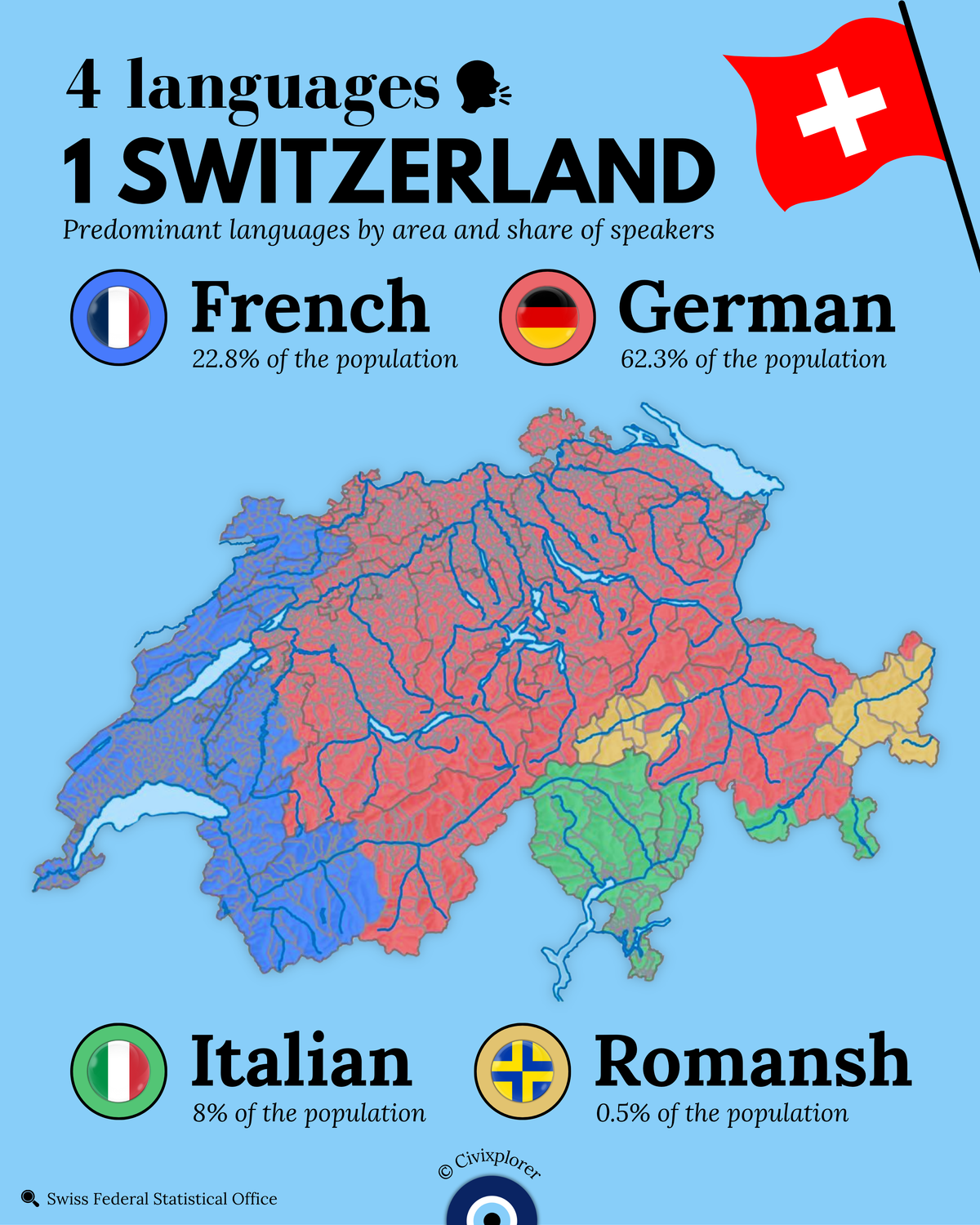
Switzerland is often described as a “Willensnation”—a nation created and held together not by a single shared language or ethnicity, but by a collective political will. The linguistic map of the country is a fascinating, territorially organized mosaic that reflects centuries of history, migration, and geographic isolation. While the borders on a map may look sharp, the reality on the ground is a complex balance of spatial compartmentalization and institutional stability.
The Demographic Breakdown
According to data from the Swiss Federal Statistical Office, the country recognizes four national languages: German (62.3%), French (22.8%), Italian (8%), and Romansh (0.5%). If you do the math, these four groups account for 93.6% of the resident population. The remaining 6.4% represents the growing influence of non-national languages, such as English, Portuguese, and Albanian, which are increasingly spoken as primary languages due to modern immigration.
A Geographic and Cultural Mosaic
The distribution of these languages is deeply rooted in the physical landscape. The German-speaking region covers the north, center, and east, making it the largest linguistic area. However, this region operates under a system of diglossia. While Standard German is used for writing and formal education, the daily vernacular consists of various Alemannic dialects known collectively as Swiss German.
To the west lies Romandy, the French-speaking heartland. The invisible cultural and linguistic line separating the French and German regions is known as the Röstigraben (the "Rösti ditch"). This divide is more than just linguistic; it often reflects differences in political voting patterns and social attitudes. To the south, the soaring peaks of the Alps act as a natural barrier that has preserved the Italian-speaking character of Ticino and the southern valleys of Graubünden, maintaining deep cultural ties with neighboring Italy.
The Alpine Survivor: Romansh
Perhaps the most intriguing part of the Swiss map is the scattered yellow pockets in the southeast. Romansh is a Rhaeto-Romance language descending from Vulgar Latin. Its survival in the deep valleys of the Canton of Graubünden is a testament to the extreme topographic isolation of the region. Despite having only about 40,000 primary speakers and being fragmented into five distinct regional idioms, Romansh remains a vital symbol of Swiss cultural preservation.
Why the System Works
The secret to Switzerland’s linguistic peace lies in strong federalism and local autonomy. Cantons have the right to choose their own official languages, which has led to the creation of officially bilingual cantons like Bern, Fribourg, and Valais, and the trilingual canton of Graubünden. This decentralized approach, combined with a culture of direct democracy and compromise, ensures that linguistic majorities cannot easily impose their will on minorities.
Ultimately, the Swiss model demonstrates how a country can turn linguistic diversity into a core element of national identity rather than a source of division, resulting in one of the most stable and successful multicultural societies in the world.

Comments (0)
Join the Conversation
Login to share your thoughts with the community.
Login to Comment