
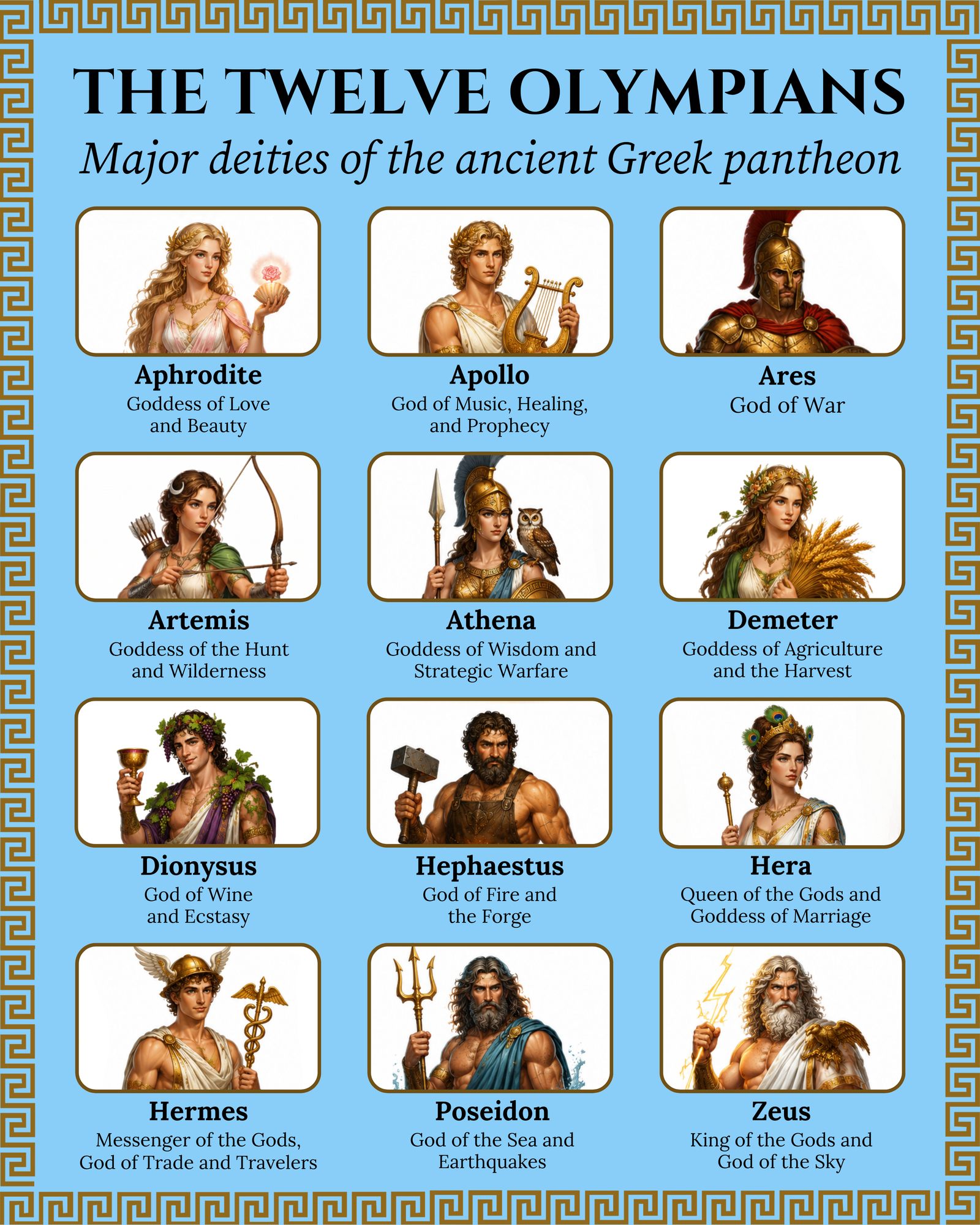
The Dodekatheon, or the twelve major deities of the ancient Greek pantheon, represents one of the most enduring mythological systems in human history. Believed to reside on the heights of Mount Olympus, these gods formed a divine hierarchy that mirrored the complexities of Greek society, governance, and the natural world. While modern interpretations often present them as a static list, the historical reality of the Olympians was fluid, evolving alongside the city-states that worshipped them.
The Foundational Generation
The power structure of Olympus was rooted in a violent transition from the rule of the Titans. The core of the pantheon consisted of the children of Cronus and Rhea: Zeus, Hera, Poseidon, and Demeter. As the King of the Gods, Zeus enforced divine order and justice, wielding the thunderbolt as a symbol of absolute authority. His wife and sister, Hera, presided over marriage and queenship, acting as a fierce protector of family structures despite the frequent infighting of the divine family.
The domains of the siblings extended to the very bedrock of survival. Poseidon governed the seas and earthquakes, representing the uncontrollable forces of nature, while Demeter oversaw agriculture and the harvest. Her mythology, particularly the abduction of her daughter Persephone, provided the ancient Greeks with a profound explanatory model for the changing seasons and the cycles of life and death.
The Offspring of Zeus
The remaining members of the twelve were primarily the children of Zeus, each representing specialized aspects of human culture and civilization. Athena, born fully armed from Zeus’s head, stood as the goddess of wisdom and strategic warfare, contrasting sharply with Ares, who embodied the raw, chaotic brutality of battle.
The "golden twins," Apollo and Artemis, represented a divine balance between the cultivated and the wild. Apollo presided over music, prophecy, and rationality, while Artemis guarded the untamed wilderness and the instinctual hunt. Similarly, Hermes acted as the ultimate boundary-crosser—the messenger of the gods and patron of travelers, trade, and thieves.
In the realm of creation and desire, Hephaestus and Aphrodite offered a study in contrasts. Hephaestus, the divine blacksmith, represented the power of technology and skilled labor despite his physical imperfections. In contrast, Aphrodite governed the potent forces of love, beauty, and desire, which the Greeks viewed as essential yet often disruptive elements of the human experience.
The Mystery of the Twelfth Seat
A fascinating historical nuance lies in the identity of the twelfth Olympian. While Dionysus, the god of wine and ecstasy, is a standard inclusion in many modern lists, ancient accounts often fluctuated between him and Hestia, the goddess of the hearth. Hestia represented the stable, sacrificial flame at the center of the home and city, but as Dionysian cults gained influence through theater and ritual madness, he became a more prominent figure in the Hellenistic canon.
The Human Side of the Divine
What distinguishes the Greek gods from many other religious systems is their anthropomorphism. They were not distant or purely benevolent; they were flawed, passionate, and interventionist. They displayed jealousy, love, and deceit, making them relatable archetypes for moral and cautionary tales. To the ancient Greeks, the gods were participants in a reciprocal relationship: humans offered sacrifice and honor, and in return, the gods might grant favor or withhold their wrath. This vibrant mythological system continues to captivate the modern world because it so brilliantly dramatizes the grandeur and pettiness of the human condition.

Comments (0)
Join the Conversation
Login to share your thoughts with the community.
Login to Comment