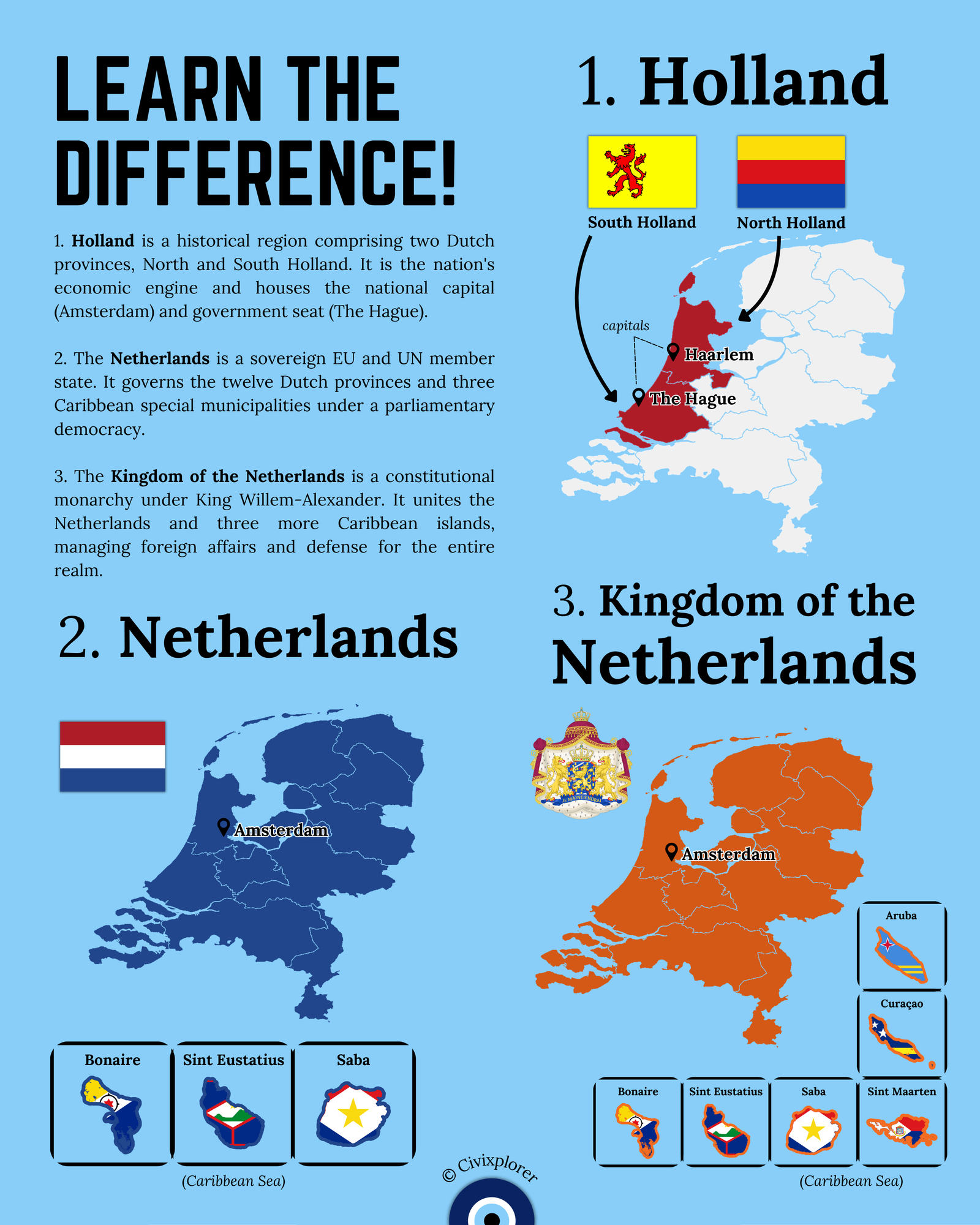
Learn the real difference between the historic provinces, the country, and the Kingdom's Caribbean territories.
Holland specifically refers to two provinces in the Netherlands—North Holland and South Holland. These were historically the most influential regions, especially during the Dutch Golden Age, when they fueled much of the nation's trade and innovation. Consequently, people worldwide adopted "Holland" as a shorthand for the whole country, despite its official name being the Netherlands.
The 1840 split of North and South Holland was an administrative reform to balance power after earlier upheavals, preventing the former unified county from overshadowing others. This is evident in governance today, where Haarlem—rather than Amsterdam—and The Hague serve as the provincial capitals of North and South Holland.
The 🇳🇱 Netherlands is the official country, composed of 12 provinces plus three Caribbean special municipalities, with North Holland being home to Amsterdam, the national capital.
Finally, there’s the Kingdom of the Netherlands, which includes not just the mainland Dutch provinces but also several territories in the Caribbean, like 🇦🇼 Aruba, 🇨🇼 Curaçao , and 🇸🇽 Sint Maarten. These territories have varying levels of autonomy, with some functioning as municipalities and others as more self-governing entities, all united under the Dutch monarchy. This broader kingdom structure stems from the Netherlands’ colonial history and evolving political relationships with its overseas territories.