Explore the Iberian Union in 1600, the global superpower uniting Spain and Portugal.
The Iberian Union (1580–1640) was a stunning, if brief, moment in history when the Habsburg monarchy commanded both the Spanish (Castile and Aragon) and Portuguese crowns. Triggered by the death of the childless King Sebastian of Portugal, Philip II of Spain utilized his lineage as the King's uncle—and his military might—to enforce his claim to the throne, forging the most powerful empire of the time.
Despite its colossal size, the union lasted only 60 years; inherent tensions, heavy taxation of Portugal to fund Spanish wars, and neglect of Portuguese colonies ultimately led to a successful coup by Portuguese nobles in 1640, ending the union.
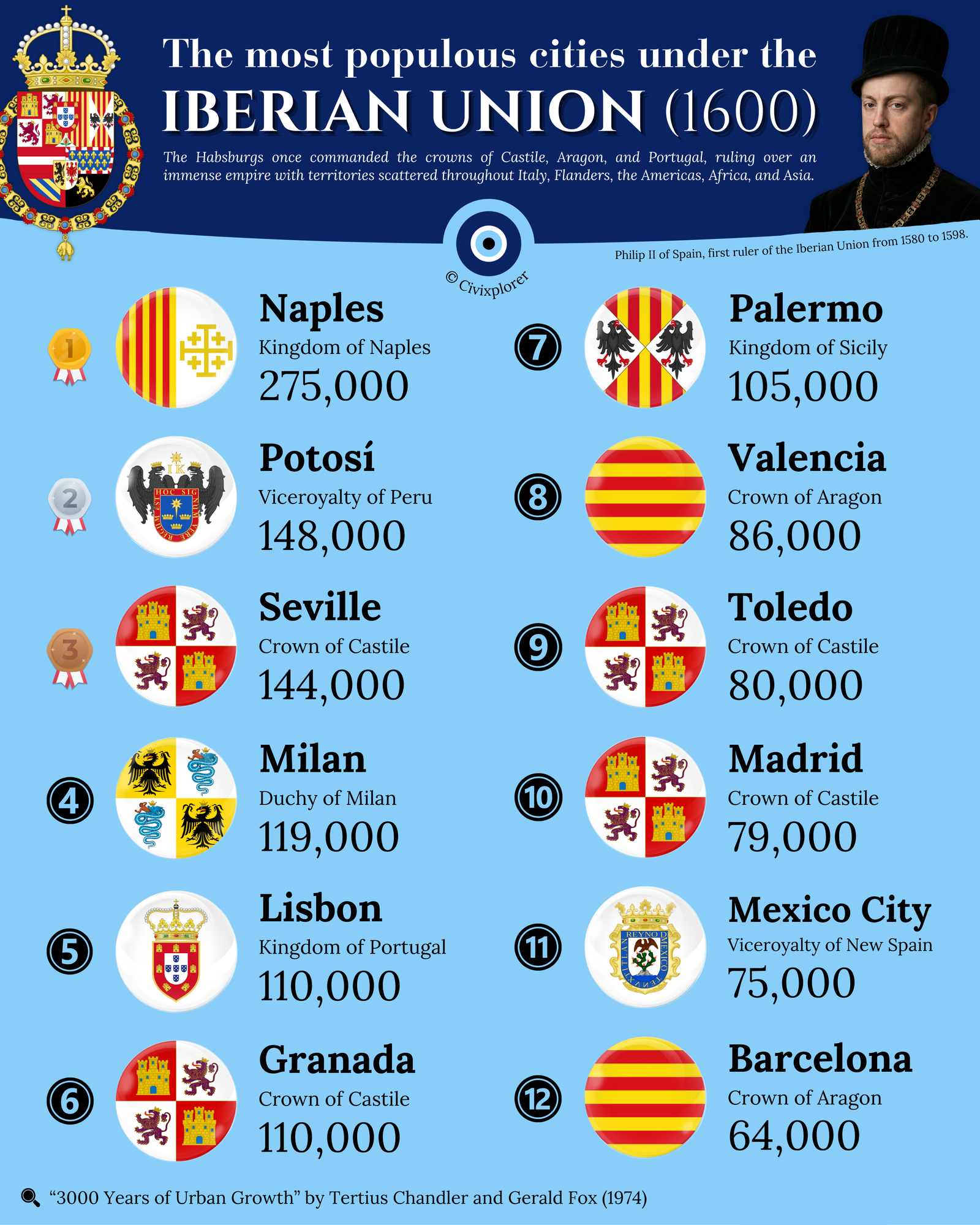
Analyzing the most populous cities under this domain around 1600 reveals the empire’s highly decentralized and global economic tilt. Topping the chart is Naples, a massive Mediterranean hub and the crown jewel of the Italian possessions. Second is Potosí in the Viceroyalty of Peru, an important colonial boomtown built on the silver of the Cerro Rico, which financed the entire empire’s endeavors.
Following closely is Seville, which thrived as the exclusive gateway for all American trade entering Europe via the Casa de Contratación.
The list showcases the rising importance of the Americas, with Mexico City serving as a major viceregal capital, while Lisbon functioned as a key nexus for the spice and slave trade. Interestingly, Madrid, despite being the chosen administrative capital by Philip II, was still significantly smaller than commercial hubs like Milan, demonstrating that the empire's power relied more on its decentralized, trading port cities than its political center.